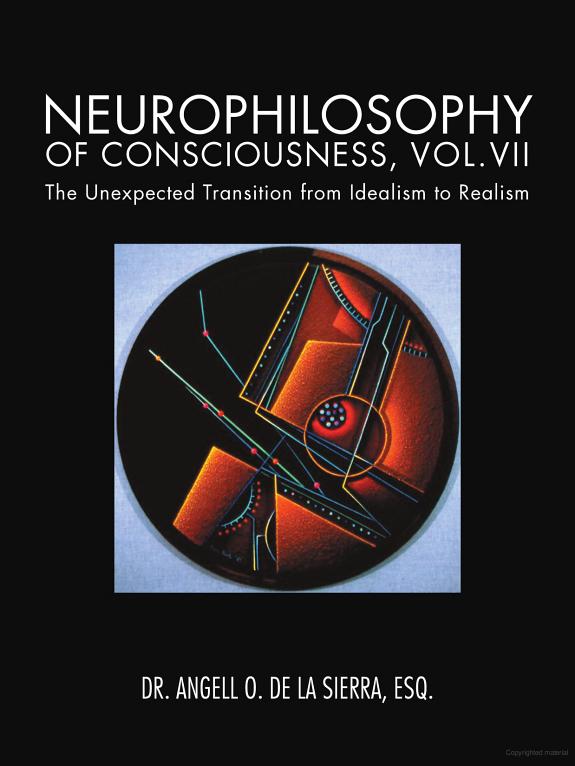
Neurophilosophy of Consciousness

Neurophilosophy of Consciousness

The Unexpected Transition from Idealism to Realism

by Dr. Angell O. de la Sierra

84 pages· 2013· ISBN 9781490712376
About
The information explosion we have witnessed in the last two decades has unexpectedly accelerated the relentless, forward evolutionary process of complexity as experienced in the ‘real’ existential reality as narrated from human to human in the language semantic accounts of our communications. Sometimes there are consistent, verifiable experiences by all witnesses that resist being described in common language terms and their undeniable presence must then be inferred by using justifiable representation and must be communicated instead in a justifiable symbolic or sentential representation as an ‘ideal’ explanation model. We then have two choices to fashion our model, we can either sacrifice the elegance of the model if we base it strictly on verifiable observables or emphasize on the elegance of a more demanding mathematical logic representation of the same subjective experience. Both approaches lead to the same speculations/conjectures about the micro or macro cosmological environment of the unseen. The author endorses the Lagrangian Quantum Field Theory (QFT) as our most empirically, well-confirmed physical theory where the ‘ideal’ explanation of the metaphysical component of the empirical object/events is more reliable than the axiomatic approach mathematical theorists prefer. However the best of both must harmonize. The reliance on verifiable sensory facts excels in the expediency of calculations and their intuitive understanding because it is closer to phenomenological experimental manipulation in the physics lab. That makes the derived metaphysical ‘ideal’ model poem more credible when applying the theory to make predictions. If we had to choose only one it is clear that when pragmatics and rigor lead to the same conclusion, then, as the author has argued, pragmatics trumps rigor due to the resulting simplicity, efficiency, and increase in understanding made possible. Most important, however, is that it allows for preparations for unexpected new environmental circumstances as they get empirically detected. Consequently, a hybrid unit wholeness of existential mesoscopic reality is defended.

Discuss Neurophilosophy of Consciousness with other readers

Join or start a book club for Neurophilosophy of Consciousness on Readfeed. Live chat, shared reading progress, and AI discussion questions — free to get started.

Frequently asked questions

How do I join a book club for Neurophilosophy of Consciousness?

Sign up free on Readfeed, then browse public clubs or start your own club with Neurophilosophy of Consciousness as the current read. Invite friends with a share link and discuss together with live chat and AI discussion questions.

Can I discuss Neurophilosophy of Consciousness with other readers online?

Yes. Readfeed book clubs let you chat live, share progress, and join discussions about Neurophilosophy of Consciousness with readers worldwide — whether your club is virtual, in-person, or hybrid.

Is Readfeed free?

Yes. Creating an account and joining book clubs is free. Sign up to find readers who love the same books and start discussing today.