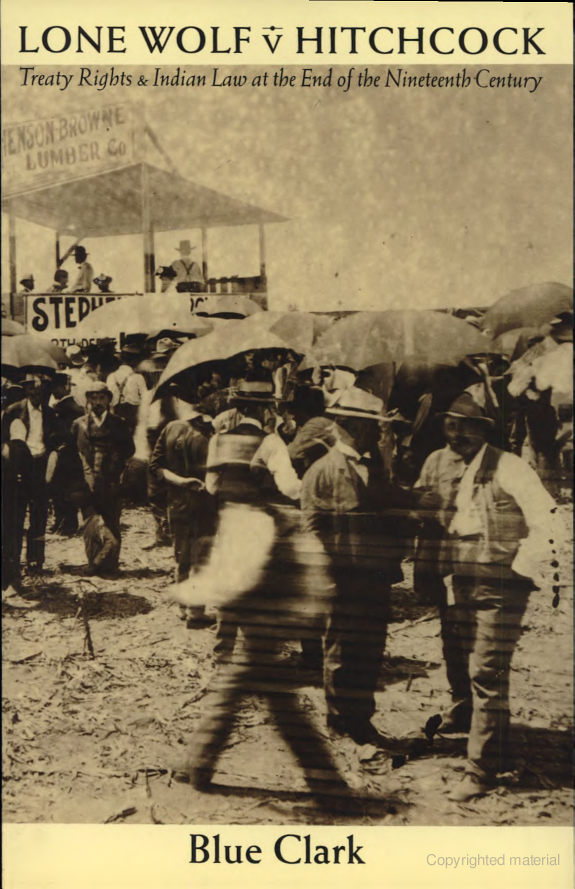
Lone Wolf V. Hitchcock

Lone Wolf V. Hitchcock

Treaty Rights and Indian Law at the End of the Nineteenth Century

by Blue Clark

182 pages· 1999· ISBN 9780803264014
About
Landmark court cases in the history of formal U.S. relations with Indian tribes are Corn Tassel, Standing Bear, Crow Dog, and Lone Wolf. Each exemplifies a problem or a process as the United States defined and codified its politics toward Indians. The importance of the Lone Wolf case of 1903 resides in its enunciation of the "plenary power" doctrine?that the United States could unilaterally act in violation of its own treaties and that Congress could dispose of land recognized by treaty as belonging to individual tribes. In 1892 the Kiowas and related Comanche and Plains Apache groups were pressured into agreeing to divide their land into allotments under the terms of the Dawes Act of 1887. Lone Wolf, a Kiowa band leader, sued to halt the land division, citing the treaties signed with the United States immediately after the Civil War. In 1902 the case reached the Supreme Court, which found that Congress could overturn the treaties through the doctrine of plenary power. As he recounts the Lone Wolf case, Clark reaches beyond the legal decision to describe the Kiowa tribe itself and its struggles to cope with Euro-American pressure on its society, attitudes, culture, economic system, and land base. The story of the case therefore also becomes the history of the tribe in the late nineteenth century. The Lone Wolf case also necessarily becomes a study of the Dawes Allotment Act of 1887 in operation; under the terms of the Dawes Act and successor legislation, almost two-thirds of Indian lands passed out of their hands within a generation. Understanding how this happened in the case of the Kiowa permits a nuanced view of the well-intentioned but ultimately disastrous allotment effort.

Discuss Lone Wolf V. Hitchcock with other readers

Join or start a book club for Lone Wolf V. Hitchcock on Readfeed. Live chat, shared reading progress, and AI discussion questions — free to get started.

Frequently asked questions

How do I join a book club for Lone Wolf V. Hitchcock?

Sign up free on Readfeed, then browse public clubs or start your own club with Lone Wolf V. Hitchcock as the current read. Invite friends with a share link and discuss together with live chat and AI discussion questions.

Can I discuss Lone Wolf V. Hitchcock with other readers online?

Yes. Readfeed book clubs let you chat live, share progress, and join discussions about Lone Wolf V. Hitchcock with readers worldwide — whether your club is virtual, in-person, or hybrid.

Is Readfeed free?

Yes. Creating an account and joining book clubs is free. Sign up to find readers who love the same books and start discussing today.