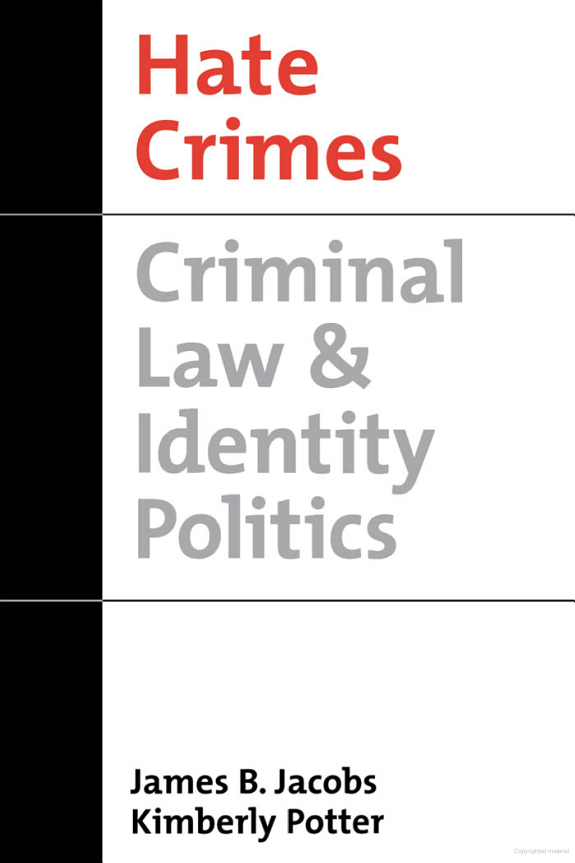
Hate Crimes
Criminal Law and Identity Politics
by James B. Jacobs, Kimberly Potter
224 pages· 2000· ISBN 9780198032229
About
In the early 1980s, a new category of crime appeared in the criminal law lexicon. In response to concerted advocacy-group lobbying, Congress and many state legislatures passed a wave of "hate crime" laws requiring the collection of statistics on, and enhancing the punishment for, crimes motivated by certain prejudices. This book places the evolution of the hate crime concept in socio-legal perspective. James B. Jacobs and Kimberly Potter adopt a skeptical if not critical stance, maintaining that legal definitions of hate crime are riddled with ambiguity and subjectivity. No matter how hate crime is defined, and despite an apparent media consensus to the contrary, the authors find no evidence to support the claim that the United States is experiencing a hate crime epidemic--instead, they cast doubt on whether the number of hate crimes is even increasing. The authors further assert that, while the federal effort to establish a reliable hate crime accounting system has failed, data collected for this purpose have led to widespread misinterpretation of the state of intergroup relations in this country. The book contends that hate crime as a socio-legal category represents the elaboration of an identity politics now manifesting itself in many areas of the law. But the attempt to apply the anti-discrimination paradigm to criminal law generates problems and anomalies. For one thing, members of minority groups are frequently hate crime perpetrators. Moreover, the underlying conduct prohibited by hate crime law is already subject to criminal punishment. Jacobs and Potter question whether hate crimes are worse or more serious than similar crimes attributable to other anti-social motivations. They also argue that the effort to single out hate crime for greater punishment is, in effect, an effort to punish some offenders more seriously simply because of their beliefs, opinions, or values, thus implicating the First Amendment. Advancing a provocative argument in clear and persuasive terms, Jacobs and Potter show how the recriminalization of hate crime has little (if any) value with respect to law enforcement or criminal justice. Indeed, enforcement of such laws may exacerbate intergroup tensions rather than eradicate prejudice.
Discuss Hate Crimes with other readers
Join or start a book club for Hate Crimes on Readfeed. Live chat, shared reading progress, and AI discussion questions — free to get started.
Frequently asked questions
How do I join a book club for Hate Crimes?
Sign up free on Readfeed, then browse public clubs or start your own club with Hate Crimes as the current read. Invite friends with a share link and discuss together with live chat and AI discussion questions.
Can I discuss Hate Crimes with other readers online?
Yes. Readfeed book clubs let you chat live, share progress, and join discussions about Hate Crimes with readers worldwide — whether your club is virtual, in-person, or hybrid.
Is Readfeed free?
Yes. Creating an account and joining book clubs is free. Sign up to find readers who love the same books and start discussing today.