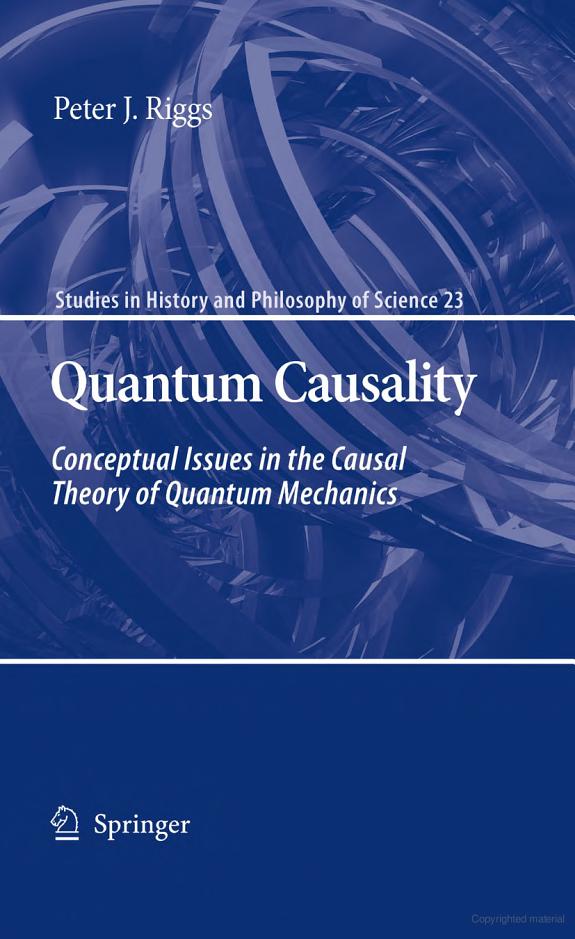
Quantum Causality

Quantum Causality

Conceptual Issues in the Causal Theory of Quantum Mechanics

by Peter J. Riggs

230 pages· 2009· ISBN 9789048124039
About
There is no sharp dividing line between the foundations of physics and philosophy of physics. This is especially true for quantum mechanics. The debate on the interpretation of quantum mechanics has raged in both the scientific and philosophical communities since the 1920s and continues to this day. (We shall understand the unqualified term ‘quantum mechanics’ to mean the mathematical formalism, i. e. laws and rules by which empirical predictions and theoretical advances are made. ) There is a popular rendering of quantum mechanics which has been publicly endorsed by some well known physicists which says that quantum mechanics is not only 1 more weird than we imagine but is weirder than we can imagine. Although it is readily granted that quantum mechanics has produced some strange and counter-intuitive results, the case will be presented in this book that quantum mechanics is not as weird as we might have been led to believe! The prevailing theory of quantum mechanics is called Orthodox Quantum Theory (also known as the Copenhagen Interpretation). Orthodox Quantum Theory endows a special status on measurement processes by requiring an intervention of an observer or an observer’s proxy (e. g. a measuring apparatus). The placement of the observer (or proxy) is somewhat arbitrary which introduces a degree of subjectivity. Orthodox Quantum Theory only predicts probabilities for measured values of physical quantities. It is essentially an instrumental theory, i. e.

Discuss Quantum Causality with other readers

Join or start a book club for Quantum Causality on Readfeed. Live chat, shared reading progress, and AI discussion questions — free to get started.

Frequently asked questions

How do I join a book club for Quantum Causality?

Sign up free on Readfeed, then browse public clubs or start your own club with Quantum Causality as the current read. Invite friends with a share link and discuss together with live chat and AI discussion questions.

Can I discuss Quantum Causality with other readers online?

Yes. Readfeed book clubs let you chat live, share progress, and join discussions about Quantum Causality with readers worldwide — whether your club is virtual, in-person, or hybrid.

Is Readfeed free?

Yes. Creating an account and joining book clubs is free. Sign up to find readers who love the same books and start discussing today.