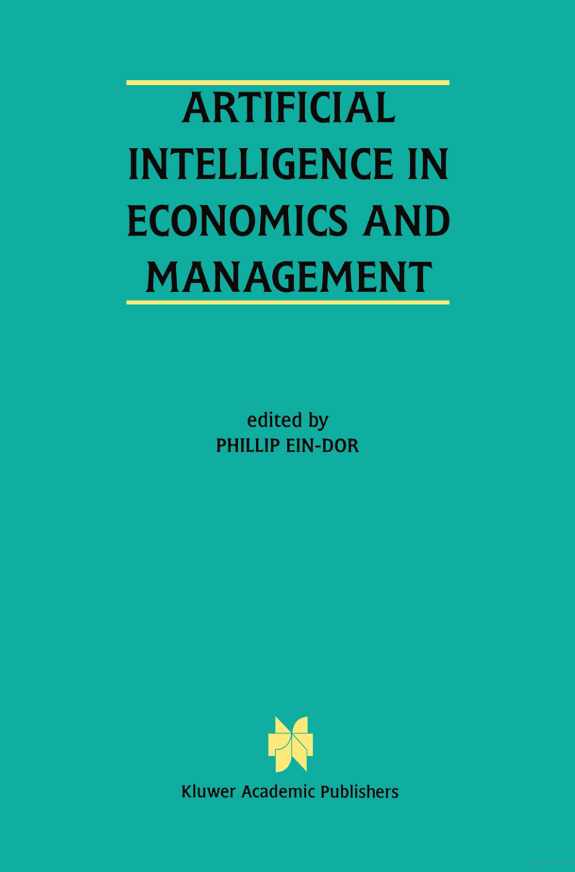
Artificial Intelligence in Economics and Managment

Artificial Intelligence in Economics and Managment

An Edited Proceedings on the Fourth International Workshop: AIEM4 Tel-Aviv, Israel, January 8–10, 1996

by Phillip Ein-Dor

276 pages· 2012· ISBN 9781461314271
About
In the past decades several researchers have developed statistical models for the prediction of corporate bankruptcy, e. g. Altman (1968) and Bilderbeek (1983). A model for predicting corporate bankruptcy aims to describe the relation between bankruptcy and a number of explanatory financial ratios. These ratios can be calculated from the information contained in a company's annual report. The is to obtain a method for timely prediction of bankruptcy, a so ultimate purpose called "early warning" system. More recently, this subject has attracted the attention of researchers in the area of machine learning, e. g. Shaw and Gentry (1990), Fletcher and Goss (1993), and Tam and Kiang (1992). This research is usually directed at the comparison of machine learning methods, such as induction of classification trees and neural networks, with the "standard" statistical methods of linear discriminant analysis and logistic regression. In earlier research, Feelders et al. (1994) performed a similar comparative analysis. The methods used were linear discriminant analysis, decision trees and neural networks. We used a data set which contained 139 annual reports of Dutch industrial and trading companies. The experiments showed that the estimated prediction error of both the decision tree and neural network were below the estimated error of the linear discriminant. Thus it seems that we can gain by replacing the "traditionally" used linear discriminant by a more flexible classification method to predict corporate bankruptcy. The data set used in these experiments was very small however.

Discuss Artificial Intelligence in Economics and Managment with other readers

Join or start a book club for Artificial Intelligence in Economics and Managment on Readfeed. Live chat, shared reading progress, and AI discussion questions — free to get started.

Frequently asked questions

How do I join a book club for Artificial Intelligence in Economics and Managment?

Sign up free on Readfeed, then browse public clubs or start your own club with Artificial Intelligence in Economics and Managment as the current read. Invite friends with a share link and discuss together with live chat and AI discussion questions.

Can I discuss Artificial Intelligence in Economics and Managment with other readers online?

Yes. Readfeed book clubs let you chat live, share progress, and join discussions about Artificial Intelligence in Economics and Managment with readers worldwide — whether your club is virtual, in-person, or hybrid.

Is Readfeed free?

Yes. Creating an account and joining book clubs is free. Sign up to find readers who love the same books and start discussing today.