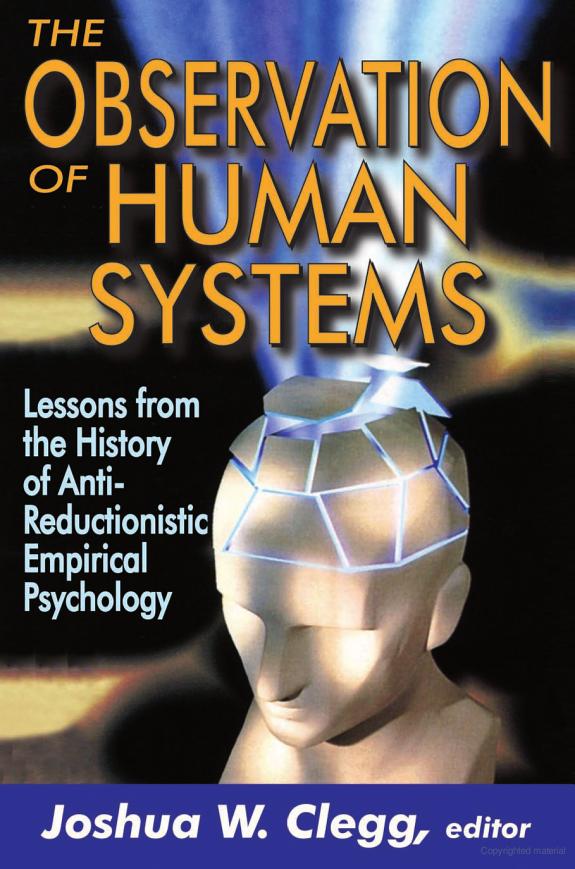
The Observation of Human Systems

The Observation of Human Systems

Lessons from the History of Anti-Reductionistic Empirical Psychology

by Joshua W. Clegg

312 pages· 2011· ISBN 9781412812276
About
Contemporary mainstream psychology has moved toward methodological specificity bounded by instrumental experimentalism. However, this institutional reduction of sanctioned methods has not been fully embraced by all social scientists, nor even by all experimental psychologists. The social sciences are rife with examples of practicing empirical scientists disaffected with the reductionism and atomism of traditional experimentalism. The empirical theory and practice of four of these disaffected social scientists--Lev Vygotsky, James Baldwin, James Gibson, and Kurt Lewin--is explored in this volume. Each of the scientists considered here argued for a rigorously empirical method while still maintaining a clear anti-reductionist stance. They justified their disaffection with the dominant psychological paradigms of their respective eras in terms of a fidelity to their phenomena of study, a fidelity they believed would be compromised by radical reductionism and ontological atomism. The authors in this collection explore the theory and practice of these eminent researchers and from it find inspiration for contemporary social science. The primary argument running through these analyses is that the social sciences should take seriously the notion of holistic empirical investigation. This means, among other things, re-establishing the indissoluble ties between theory, method and procedure and resisting the manualization of research procedures. It also means developing theories of relations and not simply of elemental properties. Such theories would concern particular units, fields, or systems of relations and not be reduced to, or interpreted in the terms of, other systems. Finally, a holistic social science requires integration of the active agent into theory, method, and procedure, an integration that points toward both participatory and emancipatory methods.

Discuss The Observation of Human Systems with other readers

Join or start a book club for The Observation of Human Systems on Readfeed. Live chat, shared reading progress, and AI discussion questions — free to get started.

Frequently asked questions

How do I join a book club for The Observation of Human Systems?

Sign up free on Readfeed, then browse public clubs or start your own club with The Observation of Human Systems as the current read. Invite friends with a share link and discuss together with live chat and AI discussion questions.

Can I discuss The Observation of Human Systems with other readers online?

Yes. Readfeed book clubs let you chat live, share progress, and join discussions about The Observation of Human Systems with readers worldwide — whether your club is virtual, in-person, or hybrid.

Is Readfeed free?

Yes. Creating an account and joining book clubs is free. Sign up to find readers who love the same books and start discussing today.