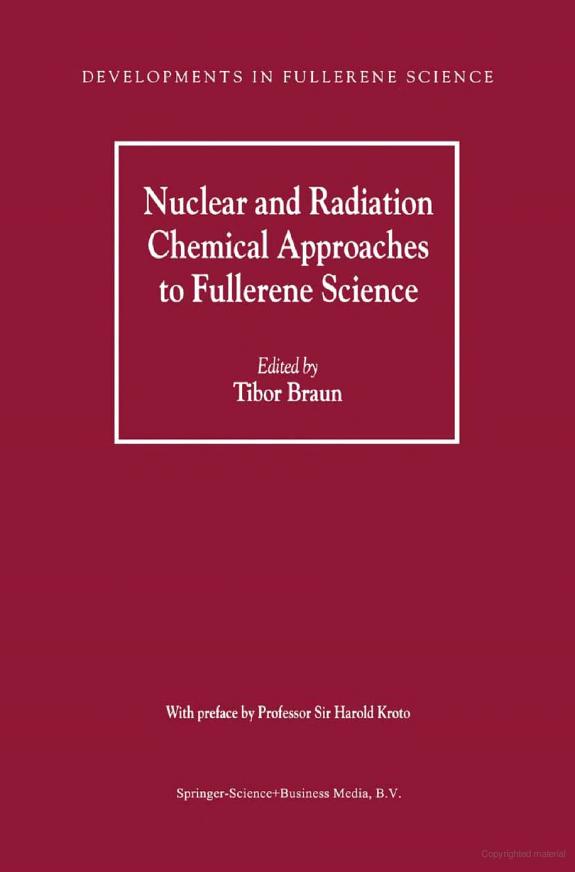
Nuclear and Radiation Chemical Approaches to Fullerene Science

Nuclear and Radiation Chemical Approaches to Fullerene Science

by Tibor Braun

203 pages· 2013· ISBN 9789401594196
About
Sir Harold W. Kroto, FRS Although the discovery of C is now almost 15 years old and the extraction occurred 60 nearly ten years ago it is amazing that the range of spin-off research still seems to expand without limits. The birth of the Fullerenes has spawned fascinating research programmes in almost every area of chemistry and physics and this monograph explores a particularly interesting and important area - the behaviour of these pure carbon cages in the presence of high-energy radiation. The C molecules must also be in the space 60 between the stars (albeit in quantities too small to detect at this time) as the conditions in the atmospheres of some carbon stars appear to be almost identical to the plasmas generated in the Kratschmer-Huffman system for making C . The conditions in space 60 are very varied as it is pervaded by a plethora of high-energy particles (photons, cosmic rays, etc. ) and the chapters in this book discuss, among other things, the response of C 60 and various derivatives to probing by a range of high-energy particles. Various fullerenes and fullerene salts have been examined by positron annihilation techniques, revealing details of their electronic and structural properties as well as phase transition behaviour. Muons have been implanted to enable f. lSR techniques to probe with high sensitivity the endohedral electronic structures of fullerenes including those in superconducting systems.

Discuss Nuclear and Radiation Chemical Approaches to Fullerene Science with other readers

Join or start a book club for Nuclear and Radiation Chemical Approaches to Fullerene Science on Readfeed. Live chat, shared reading progress, and AI discussion questions — free to get started.

Frequently asked questions

How do I join a book club for Nuclear and Radiation Chemical Approaches to Fullerene Science?

Sign up free on Readfeed, then browse public clubs or start your own club with Nuclear and Radiation Chemical Approaches to Fullerene Science as the current read. Invite friends with a share link and discuss together with live chat and AI discussion questions.

Can I discuss Nuclear and Radiation Chemical Approaches to Fullerene Science with other readers online?

Yes. Readfeed book clubs let you chat live, share progress, and join discussions about Nuclear and Radiation Chemical Approaches to Fullerene Science with readers worldwide — whether your club is virtual, in-person, or hybrid.

Is Readfeed free?

Yes. Creating an account and joining book clubs is free. Sign up to find readers who love the same books and start discussing today.