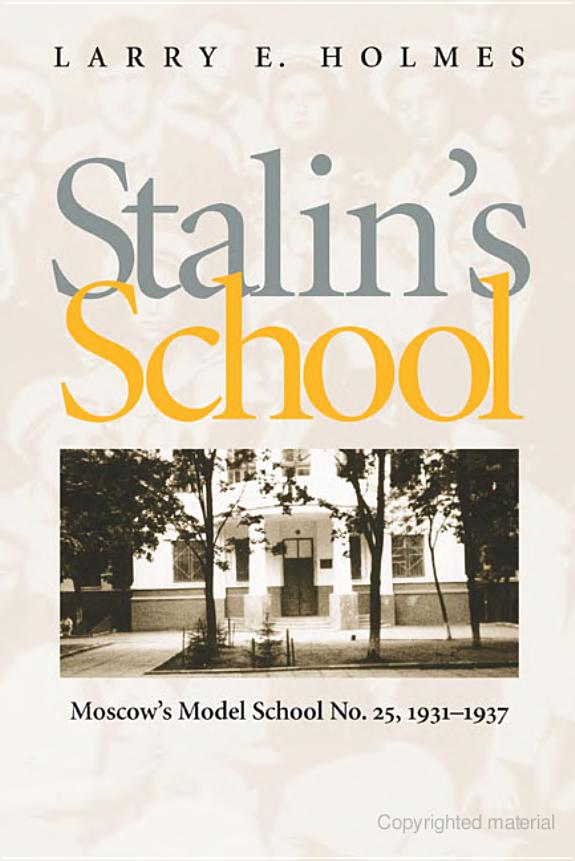
Stalin’s School
Moscow’s Model School No. 25, 1931–1937
by Larry E. Holmes
240 pages· 1999· ISBN 9780822977292
About
A different kind of history, Stalin’s School brings a unique human dimension to the Soviet Union of the 1930s and a new understanding of Stalinism as a cultural and psychological phenomenon. From 1931 to 1937, School No. 25 was the most famous and most lavishly appointed school in the Soviet Union—instructing the children of such prominent parents as Joseph Stalin, head of the Communist Party, Viacheslav Molotov, head of the Soviet State, and Paul Robeson, American actor and singer. Relying on published records, materials in eleven archives, accounts left by visiting foreigners—including the prominent American educator George Counts—and thirty six interviews with surviving pupils from the 1930s, Holmes brings the school to life. The school's administrators, teachers, pupils, friends, and foes become companions as well as objects of this study as we walk the schools halls, enter its classrooms, eavesdrop on feuding officials who debate its fate, and learn something of what the school and the period meant for its youth. Photographs of the school's teachers and students, and reproductions of the students' notebooks, drawings, and watercolors add personality to this compelling story. Holmes uses the experience of School No. 25 as a microcosm and mirror of Stalinism, illuminating the interplay of state and society in decision making, and providing an opportunity to examine Stalinism from ideological, cultural, and psychological perspectives. While placing the school's history in the context of the coercion, corruption and repression of the 1930s, Holmes challenges the prevailing view that state and public spectacle on the one hand, and society and private life, on the other, were contrasting entities. School No. 25 molded these elements into an organic whole. In the intimate setting of Stalin's School, the degree of acceptance of Stalinism transcends historians' customary reference to the fear or privilege a Soviet citizen experienced. In a mutually reinforcing way, forced compliance and voluntary choice moved individual teachers and pupils to accept a structured environment both at school and in society as the means to a powerful, prosperous, and just Soviet Union.
Discuss Stalin’s School with other readers
Join or start a book club for Stalin’s School on Readfeed. Live chat, shared reading progress, and AI discussion questions — free to get started.
Frequently asked questions
How do I join a book club for Stalin’s School?
Sign up free on Readfeed, then browse public clubs or start your own club with Stalin’s School as the current read. Invite friends with a share link and discuss together with live chat and AI discussion questions.
Can I discuss Stalin’s School with other readers online?
Yes. Readfeed book clubs let you chat live, share progress, and join discussions about Stalin’s School with readers worldwide — whether your club is virtual, in-person, or hybrid.
Is Readfeed free?
Yes. Creating an account and joining book clubs is free. Sign up to find readers who love the same books and start discussing today.