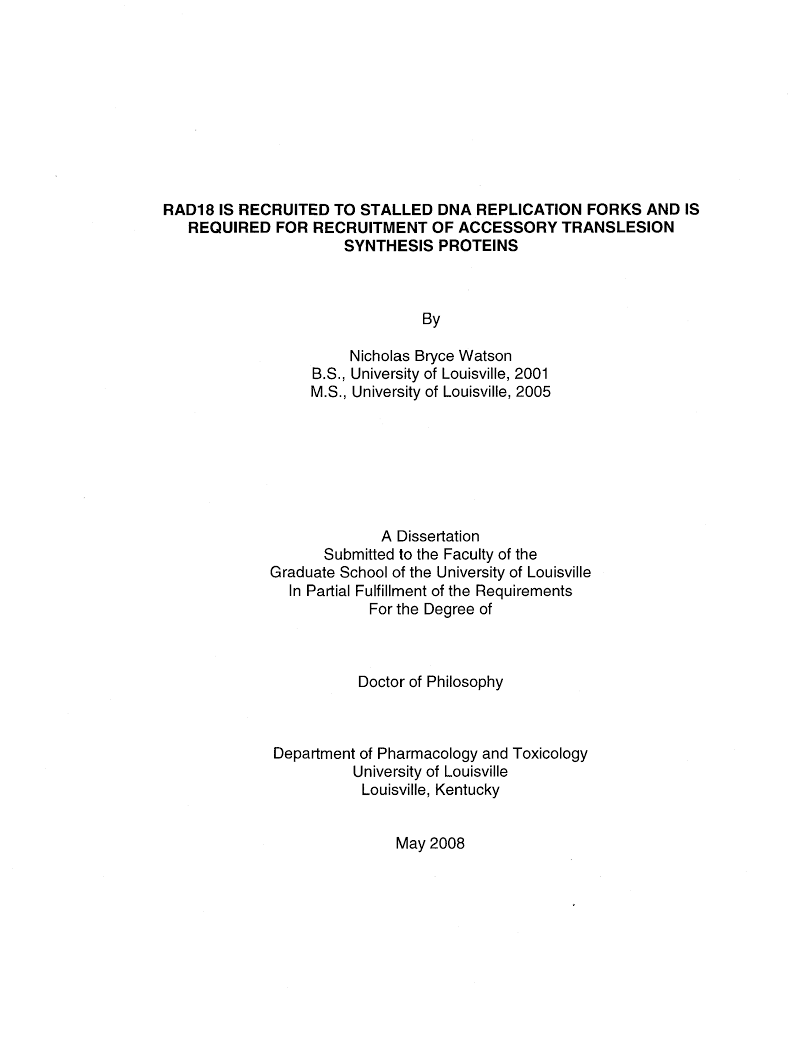
RAD18 is Recruited to Stalled DNA Replication Forks and is Required for Recruitment of Accessory Translesion Synthesis Proteins

RAD18 is Recruited to Stalled DNA Replication Forks and is Required for Recruitment of Accessory Translesion Synthesis Proteins

143 pages· 2008· ISBN 9780549548225
About
RAD18 is an integral protein involved in the DNA damage tolerance pathway, translesion synthesis. RAD18 has been studied extensively in the yeast, Saccharomyces cerevisiae, and has been found to be essential for the ubiquitination of PCNA. This modification leads to the recruitment of novel Y-family DNA polymerases whose function is to replicate through sites of DNA damage. The human homolog of RAD18 has been discovered and we tested its role in translesion synthesis using a variety of novel methods adapted for these experiments. We examined the hypothesis that RAD18 is required for mutagenic bypass of DNA damage in human cells. To do this, we determined the frequency of mutations induced in the HPRT gene by ultraviolet light (UV) or benzo[a]pyrenediolepoxide (BPDE) in diploid human fibroblasts and compared them with cells in which RAD18 protein was reduced by 85%. In the latter cells, the frequency of mutations was reduced very significantly. Proteins required for translesion DNA synthesis localize in nuclear foci of cells with replication-blocking lesions. The dynamics of this process were examined with fluorescence-based biophysical techniques. Immunohistochemical examination of the subcellular localization of RAD18 showed that the protein accumulated in nuclear foci in cells that were damaged in S-phase, but not in G1, and that these foci also contained PCNA. We studied the behavior of a RAD18-eGFP protein in living cells, and showed that the protein is freely diffusible, but becomes immobilized when cells are damaged in S-phase. Further, RAD18 is required for REV1 to be immobilized in nuclear foci after DNA damage. Fluorescence lifetime measurements indicated that RAD18 and RAD6A or pol &eegr; only transferred resonance energy when these proteins colocalized in damage-induced nuclear foci, indicating a close physical association only within such foci. Our data support a model in which RAD18 is recruited to stalled replication forks and is required for recruitment of Y-family DNA polymerases and subsequent mutagenesis.

Discuss RAD18 is Recruited to Stalled DNA Replication Forks and is Required for Recruitment of Accessory Translesion Synthesis Proteins with other readers

Join or start a book club for RAD18 is Recruited to Stalled DNA Replication Forks and is Required for Recruitment of Accessory Translesion Synthesis Proteins on Readfeed. Live chat, shared reading progress, and AI discussion questions — free to get started.

Frequently asked questions

How do I join a book club for RAD18 is Recruited to Stalled DNA Replication Forks and is Required for Recruitment of Accessory Translesion Synthesis Proteins?

Sign up free on Readfeed, then browse public clubs or start your own club with RAD18 is Recruited to Stalled DNA Replication Forks and is Required for Recruitment of Accessory Translesion Synthesis Proteins as the current read. Invite friends with a share link and discuss together with live chat and AI discussion questions.

Can I discuss RAD18 is Recruited to Stalled DNA Replication Forks and is Required for Recruitment of Accessory Translesion Synthesis Proteins with other readers online?

Yes. Readfeed book clubs let you chat live, share progress, and join discussions about RAD18 is Recruited to Stalled DNA Replication Forks and is Required for Recruitment of Accessory Translesion Synthesis Proteins with readers worldwide — whether your club is virtual, in-person, or hybrid.

Is Readfeed free?

Yes. Creating an account and joining book clubs is free. Sign up to find readers who love the same books and start discussing today.