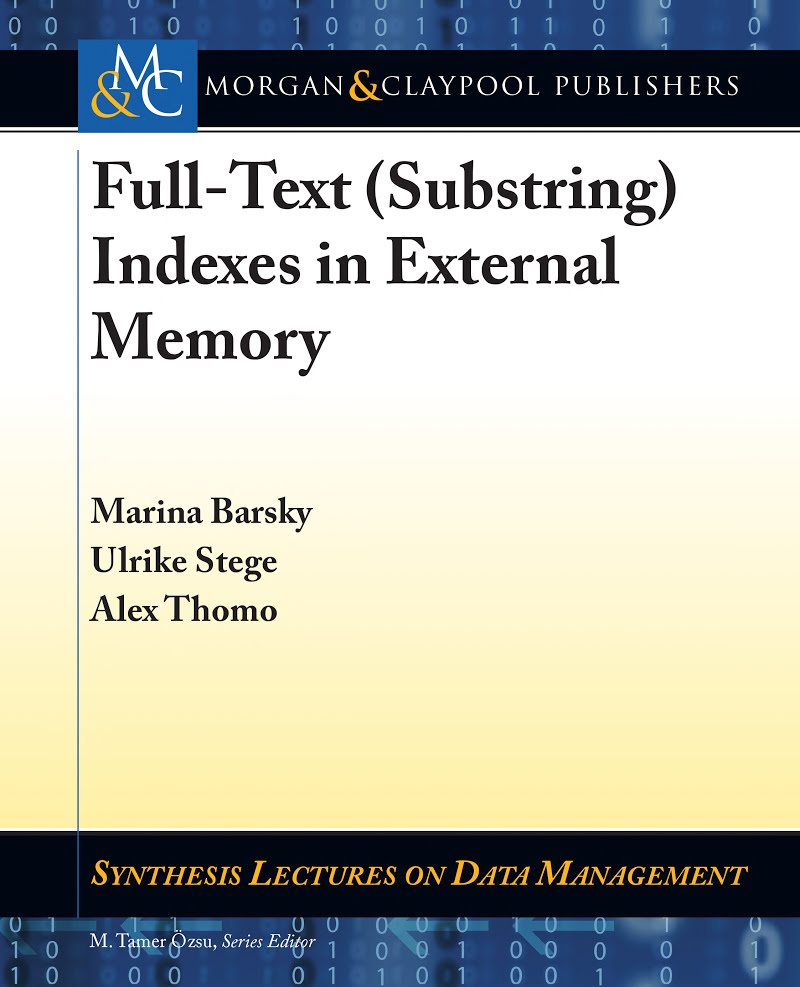
Full-Text (Substring) Indexes in External Memory

Full-Text (Substring) Indexes in External Memory

by Marina Barsky, Alex Thomo, Ulrike Stege

92 pages· 2011· ISBN 9781608457960
About
Nowadays, textual databases are among the most rapidly growing collections of data. Some of these collections contain a new type of data that differs from classical numerical or textual data. These are long sequences of symbols, not divided into well-separated small tokens (words). The most prominent among such collections are databases of biological sequences, which are experiencing today an unprecedented growth rate. Starting in 2008, the "1000 Genomes Project" has been launched with the ultimate goal of collecting sequences of additional 1,500 Human genomes, 500 each of European, African, and East Asian origin. This will produce an extensive catalog of Human genetic variations. The size of just the raw sequences in this catalog would be about 5 terabytes. Querying strings without well-separated tokens poses a different set of challenges, typically addressed by building full-text indexes, which provide effective structures to index all the substrings of the given strings. Since full-text indexes occupy more space than the raw data, it is often necessary to use disk space for their construction. However, until recently, the construction of full-text indexes in secondary storage was considered impractical due to excessive I/O costs. Despite this, algorithms developed in the last decade demonstrated that efficient external construction of full-text indexes is indeed possible. This book is about large-scale construction and usage of full-text indexes. We focus mainly on suffix trees, and show efficient algorithms that can convert suffix trees to other kinds of full-text indexes and vice versa. There are four parts in this book. They are a mix of string searching theory with the reality of external memory constraints. The first part introduces general concepts of full-text indexes and shows the relationships between them. The second part presents the first series of external-memory construction algorithms that can handle the construction of full-text indexes for moderately large strings in the order of few gigabytes. The third part presents algorithms that scale for very large strings. The final part examines queries that can be facilitated by disk-resident full-text indexes. Table of Contents: Structures for Indexing Substrings / External Construction of Suffix Trees / Scaling Up: When the Input Exceeds the Main Memory / Queries for Disk-based Indexes / Conclusions and Open Problems

Discuss Full-Text (Substring) Indexes in External Memory with other readers

Join or start a book club for Full-Text (Substring) Indexes in External Memory on Readfeed. Live chat, shared reading progress, and AI discussion questions — free to get started.

Frequently asked questions

How do I join a book club for Full-Text (Substring) Indexes in External Memory?

Sign up free on Readfeed, then browse public clubs or start your own club with Full-Text (Substring) Indexes in External Memory as the current read. Invite friends with a share link and discuss together with live chat and AI discussion questions.

Can I discuss Full-Text (Substring) Indexes in External Memory with other readers online?

Yes. Readfeed book clubs let you chat live, share progress, and join discussions about Full-Text (Substring) Indexes in External Memory with readers worldwide — whether your club is virtual, in-person, or hybrid.

Is Readfeed free?

Yes. Creating an account and joining book clubs is free. Sign up to find readers who love the same books and start discussing today.