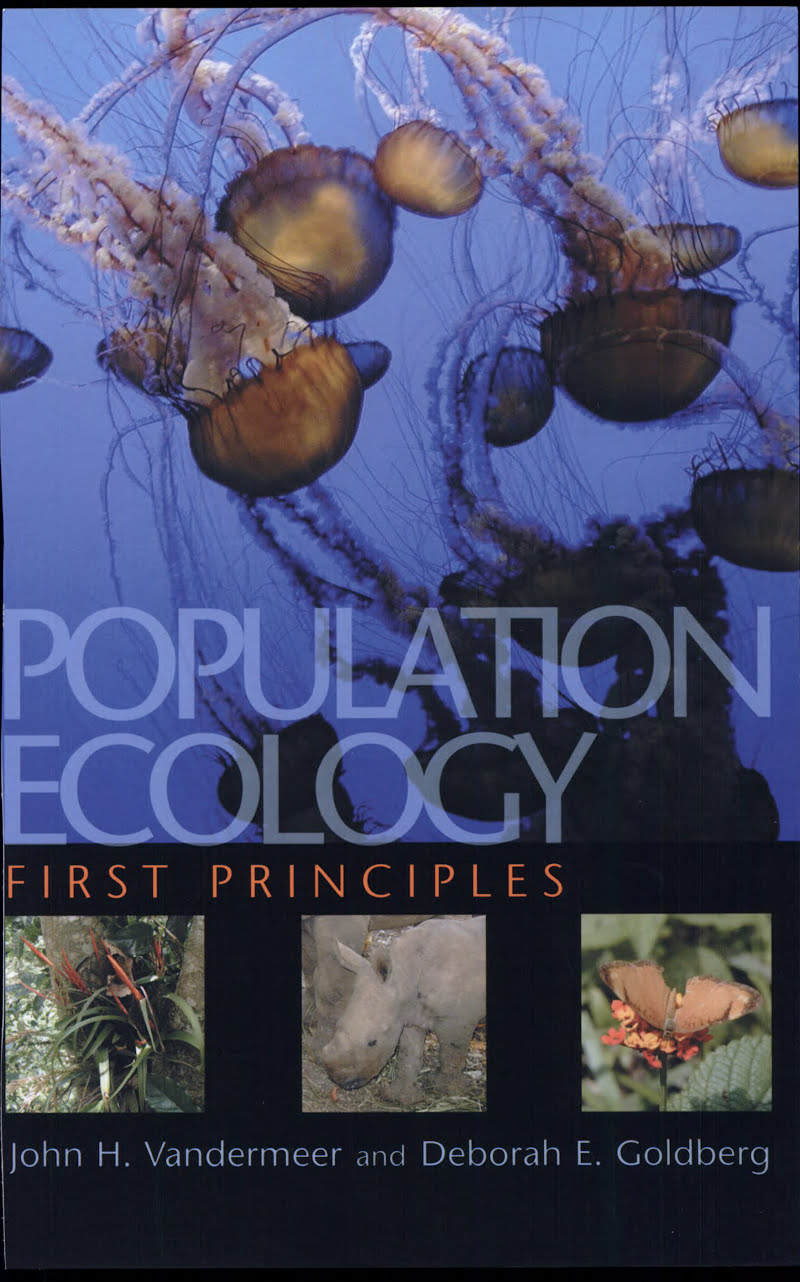
Population Ecology
First Principles
by John H. Vandermeer, Deborah Esther Goldberg
280 pages· 2003· ISBN 9780691114415
About
How can the future number of deer, agricultural pests, or cod be calculated based on the present number of individuals and their age distribution? How long will it take for a viral outbreak in a particular city to reach another city five hundred miles away? In addressing such basic questions, ecologists today are as likely to turn to complicated differential equations as to life histories--a dramatic change from thirty years ago. Population ecology is the mathematical backbone of ecology. Here, two leading experts provide the underlying quantitative concepts that all modern-day ecologists need. John Vandermeer and Deborah Goldberg show that populations are more than simply collections of individuals. Complex variables such as the size distribution of individuals and allotted territory for expanding groups come into play when mathematical models are applied. The authors build these models from the ground up, from first principles, using a much broader range of empirical examples--from plants to animals, from viruses to humans--than do standard texts. And they address several complicating issues such as age-structured populations, spatially distributed populations, and metapopulations. Beginning with a review of elementary principles, the book goes on to consider theoretical issues involving life histories, complications in the application of the core principles, statistical descriptions of spatial aggregation of individuals and populations as well as population dynamic models incorporating spatial information, and introductions to two-species interactions. Complemented by superb illustrations that further clarify the links between the mathematical models and biology, Population Ecology is the most straightforward and authoritative overview of the field to date. It will have broad appeal among undergraduates, graduate students, and practicing ecologists.
Discuss Population Ecology with other readers
Join or start a book club for Population Ecology on Readfeed. Live chat, shared reading progress, and AI discussion questions — free to get started.
Frequently asked questions
How do I join a book club for Population Ecology?
Sign up free on Readfeed, then browse public clubs or start your own club with Population Ecology as the current read. Invite friends with a share link and discuss together with live chat and AI discussion questions.
Can I discuss Population Ecology with other readers online?
Yes. Readfeed book clubs let you chat live, share progress, and join discussions about Population Ecology with readers worldwide — whether your club is virtual, in-person, or hybrid.
Is Readfeed free?
Yes. Creating an account and joining book clubs is free. Sign up to find readers who love the same books and start discussing today.