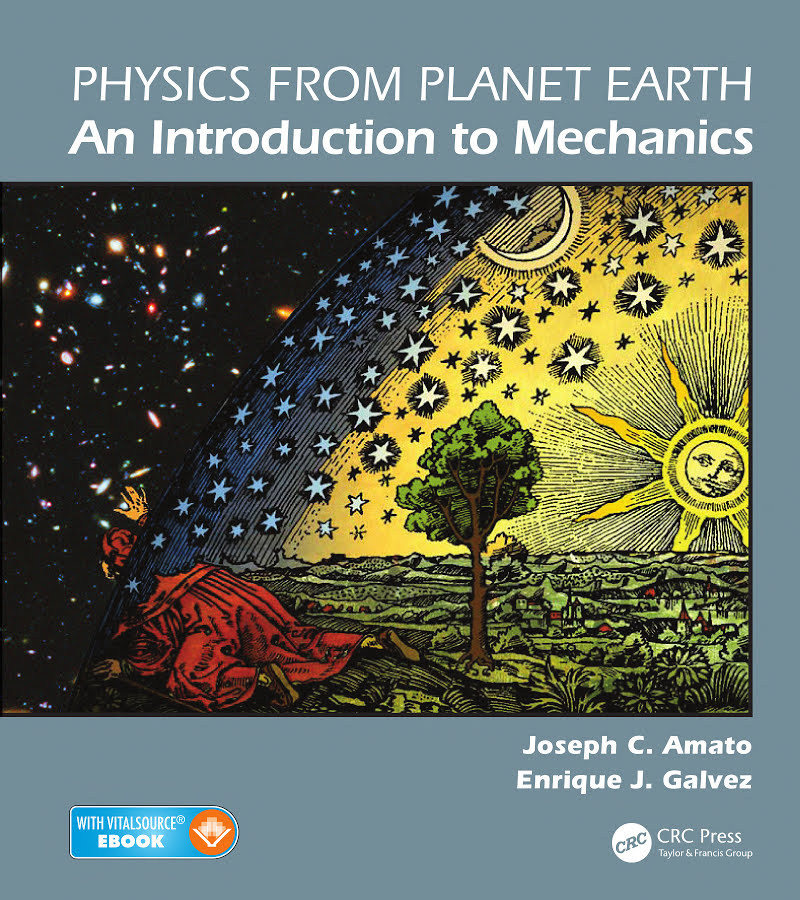
Physics from Planet Earth - An Introduction to Mechanics

Physics from Planet Earth - An Introduction to Mechanics

An Introduction to Classical Mechanics

by Joseph C. Amato, Enrique J. Galvez

611 pages· 2015· ISBN 9781498752152
About
Expose Your Students to the Elegant World of Physics in an Enticing Way Physics from Planet Earth - An Introduction to Mechanics provides a one-semester, calculus-based introduction to classical mechanics for first-year undergraduate students studying physics, chemistry, astronomy, or engineering. Developed from classroom-tested materials refined and updated for over ten years at Colgate University, the book guides students on a journey beyond standard approaches that use blocks, projectiles, and inclined planes to grander themes involving interplanetary travel, exoplanets, asteroid collisions, and dark matter. Beginning students are often bewildered by the rapid-fire presentation of physical concepts, mathematics, and problem-solving strategies in traditional introductory textbooks. In contrast, this text: Introduces the three conservation laws (momentum, energy, and angular momentum) as fundamental laws of nature from which secondary concepts, such as force and torque, are derived Organizes topics around the conservation laws, avoiding the typical "math overload" that confronts students at the start of standard courses Motivates and illustrates many topics through real, contemporary applications in astronomy, planetary science, and space travel After reviewing the basic mathematical tools needed to study mechanics, the text addresses the conservation of momentum and applications, such as gravity-assisted space travel and rocket propulsion. It next discusses Newton’s Laws and numerous space- and astronomy-based applications. The text then presents evidence for a second conservation principle, energy, which allows us to describe motion as a function of position rather than time. The book also explores the conservation of angular momentum and a variety of applications, including pulsars, orbital eccentricity, and gyroscopes. The text concludes with a discussion of dark matter, dark energy, and the ultimate fate of the universe.

Discuss Physics from Planet Earth - An Introduction to Mechanics with other readers

Join or start a book club for Physics from Planet Earth - An Introduction to Mechanics on Readfeed. Live chat, shared reading progress, and AI discussion questions — free to get started.

Frequently asked questions

How do I join a book club for Physics from Planet Earth - An Introduction to Mechanics?

Sign up free on Readfeed, then browse public clubs or start your own club with Physics from Planet Earth - An Introduction to Mechanics as the current read. Invite friends with a share link and discuss together with live chat and AI discussion questions.

Can I discuss Physics from Planet Earth - An Introduction to Mechanics with other readers online?

Yes. Readfeed book clubs let you chat live, share progress, and join discussions about Physics from Planet Earth - An Introduction to Mechanics with readers worldwide — whether your club is virtual, in-person, or hybrid.

Is Readfeed free?

Yes. Creating an account and joining book clubs is free. Sign up to find readers who love the same books and start discussing today.