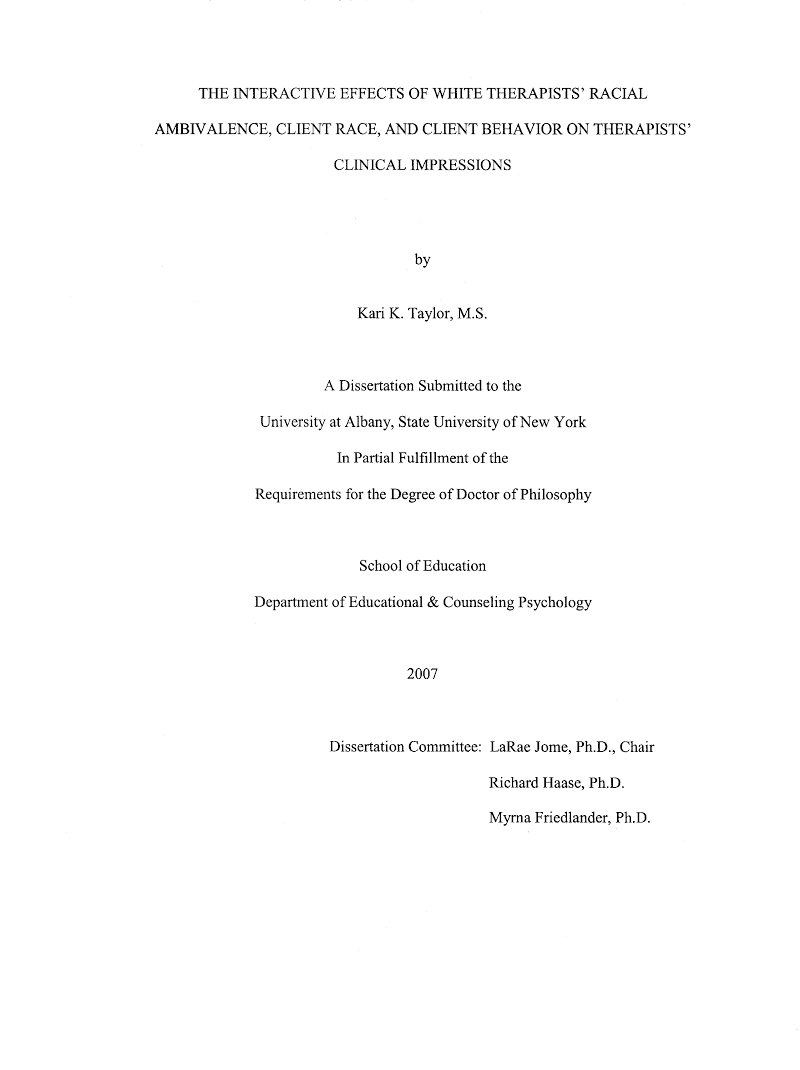
The Interactive Effects of White Therapists' Racial Ambivalence, Client Race, and Client Behavior on Therapists' Clinical Impressions

The Interactive Effects of White Therapists' Racial Ambivalence, Client Race, and Client Behavior on Therapists' Clinical Impressions

127 pages· 2007· ISBN 9780549591924
About
Given that disparities have been noted in the mental health treatment of Black and White clients, it is important to explore the process by which therapists---and White therapists in particular--form clinical judgments about clients. This study considered the potential influence of client race (Black versus White), client behavior (cooperative versus resistant) and therapists' racially ambivalent attitudes (ambivalent versus non-ambivalent) on White therapists' initial clinical impressions of a fictitious client through a web-based analogue task. Two hundred sixteen White therapists observed one of four video and clinical intake conditions: (a) Black cooperative client, (b) White cooperative client, (c) Black resistant client, or (d) White resistant client. Contrary to hypothesis, the three-way interaction among client race, client behavior and therapist racial attitudes was not significant. The main effect for therapist racial attitude was not significant; White therapists did not respond to the client differently based on their racially ambivalent attitudes. In addition, a main effect for client behavior was found. As predicted, clients exhibiting cooperative behavior were rated more favorably than resistant clients. Finally, a main effect for client race was found such that, as predicted, White therapists who observed the Black client rated him more favorably than White therapists who observed a clinically similar White client. Post hoc analyses found that the more positive racial attitudes therapists reported, the more the Black client was rated more favorably than the White client. The results of the study imply that White therapists take the race of the client into account when making clinical judgments.

Discuss The Interactive Effects of White Therapists' Racial Ambivalence, Client Race, and Client Behavior on Therapists' Clinical Impressions with other readers

Join or start a book club for The Interactive Effects of White Therapists' Racial Ambivalence, Client Race, and Client Behavior on Therapists' Clinical Impressions on Readfeed. Live chat, shared reading progress, and AI discussion questions — free to get started.

Frequently asked questions

How do I join a book club for The Interactive Effects of White Therapists' Racial Ambivalence, Client Race, and Client Behavior on Therapists' Clinical Impressions?

Sign up free on Readfeed, then browse public clubs or start your own club with The Interactive Effects of White Therapists' Racial Ambivalence, Client Race, and Client Behavior on Therapists' Clinical Impressions as the current read. Invite friends with a share link and discuss together with live chat and AI discussion questions.

Can I discuss The Interactive Effects of White Therapists' Racial Ambivalence, Client Race, and Client Behavior on Therapists' Clinical Impressions with other readers online?

Yes. Readfeed book clubs let you chat live, share progress, and join discussions about The Interactive Effects of White Therapists' Racial Ambivalence, Client Race, and Client Behavior on Therapists' Clinical Impressions with readers worldwide — whether your club is virtual, in-person, or hybrid.

Is Readfeed free?

Yes. Creating an account and joining book clubs is free. Sign up to find readers who love the same books and start discussing today.