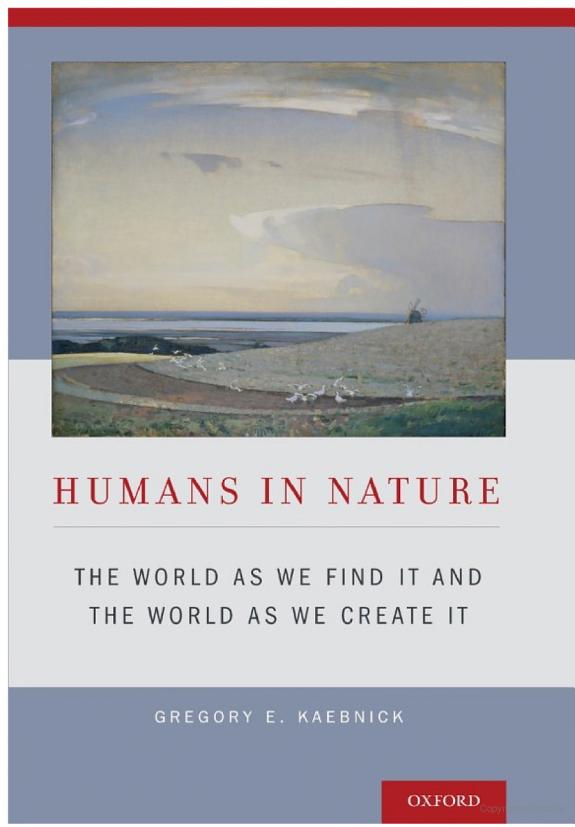
Humans in Nature
The World As We Find It and the World As We Create It
by Gregory E. Kaebnick
272 pages· 2013· ISBN 9780199347230
About
Contemporary debates over issues as wide-ranging as the protection of wildernesses and endangered species, the spread of genetically modified organisms, the emergence of synthetic biology, and the advance of human enhancement, all of which seem to spin into deeper and more baffling questions with every change in the news cycle, often circle back to the same fundamental question: should there be limits to the human alteration of the natural world? A growing number of people view the human capacity to alter natural states of affairs -- from formerly wild spaces and things around us to crops and livestock to our own human nature -- as cause for moral alarm. That reaction raises a number of perplexing philosophical questions, however: Can we identify "natural" states of affairs at all? Does the idea of being morally concerned about the human relationship to nature make any sense? Should such a concern influence public policy and politics, or should government stay strenuously neutral on such matters? Through a study of moral debates about the environment, agricultural biotechnology, synthetic biology, and human enhancement, Gregory E. Kaebnick, a research scholar at The Hastings Center and editor of the Hastings Center Report, argues that concerns about the human alteration of nature can be legitimate and serious, but also that they are complex, contestable, and of limited political force. Kaebnick defends attempts to identify "natural" states of affairs by disentangling the nature/artifact distinction from metaphysical hoariness. Drawing on David Hume, he also defends moral standards for the human relationship to nature, arguing that they, and moral standards generally, should be understood as grounded in what Hume called the "passions." Yet what counts as "natural" can be delineated only roughly, he concludes, and moral standards for interaction with nature are less a matter of obligation than of ideals. Kaebnick also concludes, drawing on an interpretation of the liberal principle of neutrality, that government may support those standards but must be careful not to enforce them. Thus Kaebnick looks for a middle way on debates that have tended toward polarization. "As differences between nature and artifact become steadily less substantial, problems about preservation run to the core of how people can make sense of themselves, of each other, and of our shared world. Kaebnick's solutions are creative and compelling, theoretically elegant and politically practical. Providing distinctive ways forward, when much academic and policy discussion seems exhausted, his book demands wide attention. In return, it inspires hope." - James Nelson, Michigan State University
Discuss Humans in Nature with other readers
Join or start a book club for Humans in Nature on Readfeed. Live chat, shared reading progress, and AI discussion questions — free to get started.
Frequently asked questions
How do I join a book club for Humans in Nature?
Sign up free on Readfeed, then browse public clubs or start your own club with Humans in Nature as the current read. Invite friends with a share link and discuss together with live chat and AI discussion questions.
Can I discuss Humans in Nature with other readers online?
Yes. Readfeed book clubs let you chat live, share progress, and join discussions about Humans in Nature with readers worldwide — whether your club is virtual, in-person, or hybrid.
Is Readfeed free?
Yes. Creating an account and joining book clubs is free. Sign up to find readers who love the same books and start discussing today.