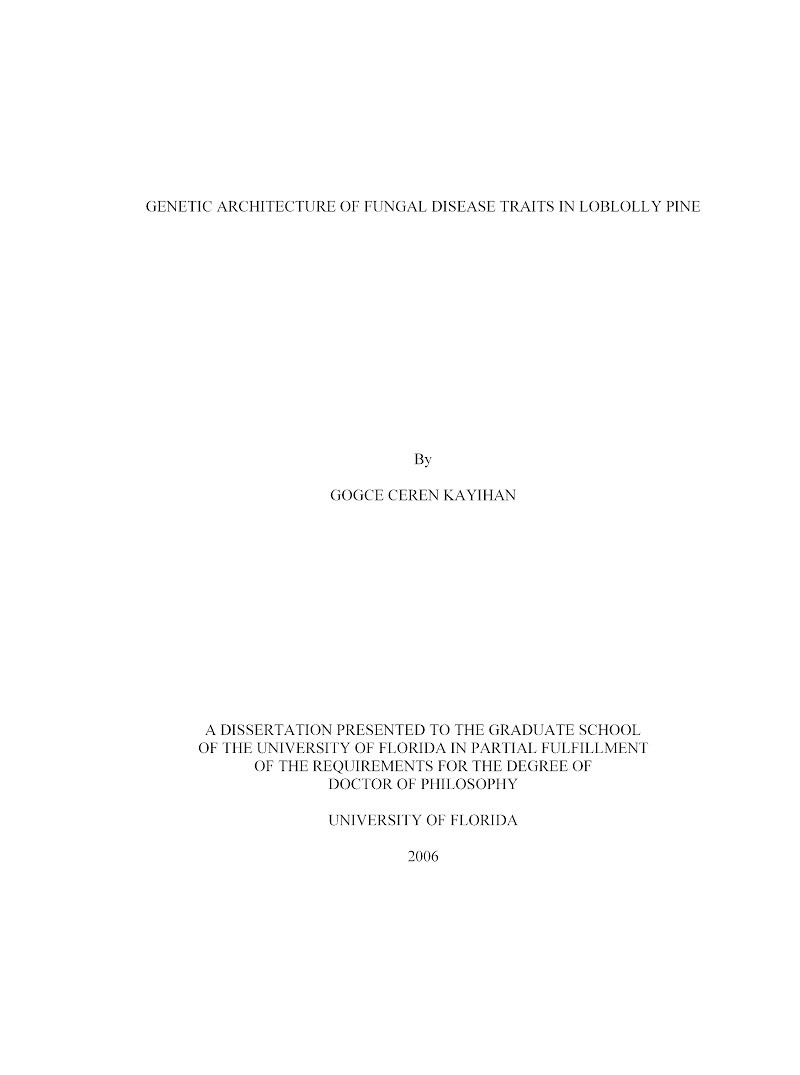
Genetic Architecture of Fungal Disease Traits in Loblolly Pine

Genetic Architecture of Fungal Disease Traits in Loblolly Pine

136 pages· 2006· ISBN 9780542806452
About
In the southeastern United States, loblolly pine (Pinus taeda L) is the most common tree species covering nearly 13.4 hectares in southern United States with over 1 billion seedlings produced every year. This popular pine species bring $30 billion and 110,000 jobs to the region. However, two endemic fungal diseases are threatening this productive view: fusiform rust incited by Cronartium quercuum Berk. Miyable ex Shirai f. sp. fusiforme and pitch canker incited by Fusarium circinatum Nirenberg et O'Donnell. Loblolly pine is not totally susceptible to these diseases and it has been shown by many researchers, using natural and artificial inoculations, that loblolly pine families show genetic variation in resistance to both fusiform rust and pitch canker diseases. Precision was acquired by a combination of clonal propagation, which allows repeat observations of the same genotypes and the use of a mixed linear model (GAREML) to adjust for environmental effects. In the first part of this study, I identified traits, clones, families, and parents that guide a genetic approach to dissecting disease traits in loblolly pine. I verified that pitch canker and fusiform rust traits are heritable and identified the disease traits that are genetically distinct from one another. Second, I used DNA marker information that was developed in previous mapping studies to distinguish host genotypes that carry/lack the pathotype-specific Fr1 allele. I tested the hypothesis that the Fr1 allele is predictive of resistance in greenhouse and field experiments. Because these studies involved clonally propagated materials, I also quantified the extent to which genetic and non-genetic factors influence disease expression levels and escape rate in greenhouse and field trials. Finally, I used gene expression data obtained from a very complex design of microarray experiments using diseased and healthy loblolly pine clones from a family that is segregating for Fr1, to identify genes that are differentially regulated in diseased and healthy individuals. I contrasted gene expression in diseased and healthy individuals over a time frame of 4 months. Together, these studies revealed the genetic architecture of fusiform rust disease resistance in scales ranging from the population level to the molecular level.

Discuss Genetic Architecture of Fungal Disease Traits in Loblolly Pine with other readers

Join or start a book club for Genetic Architecture of Fungal Disease Traits in Loblolly Pine on Readfeed. Live chat, shared reading progress, and AI discussion questions — free to get started.

Frequently asked questions

How do I join a book club for Genetic Architecture of Fungal Disease Traits in Loblolly Pine?

Sign up free on Readfeed, then browse public clubs or start your own club with Genetic Architecture of Fungal Disease Traits in Loblolly Pine as the current read. Invite friends with a share link and discuss together with live chat and AI discussion questions.

Can I discuss Genetic Architecture of Fungal Disease Traits in Loblolly Pine with other readers online?

Yes. Readfeed book clubs let you chat live, share progress, and join discussions about Genetic Architecture of Fungal Disease Traits in Loblolly Pine with readers worldwide — whether your club is virtual, in-person, or hybrid.

Is Readfeed free?

Yes. Creating an account and joining book clubs is free. Sign up to find readers who love the same books and start discussing today.