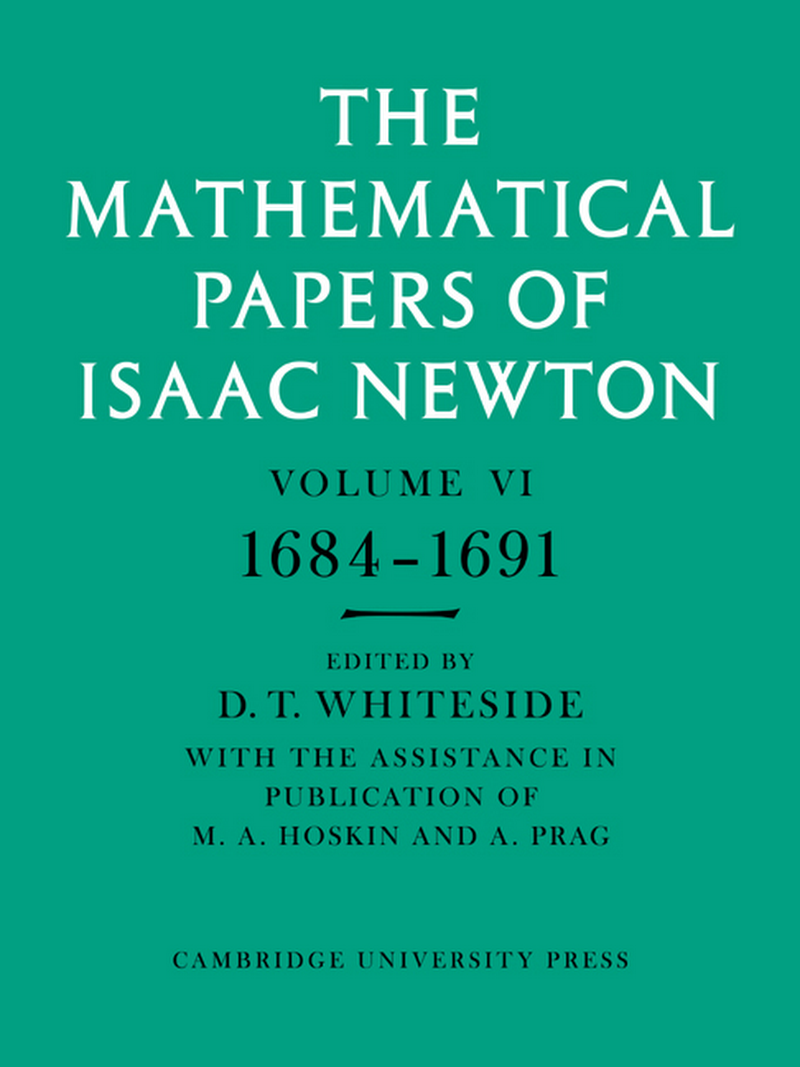
1684-1691
by Isaac Newton, D. T. Whiteside
660 pages· 2008· ISBN 9780521045858
About
This volume reproduces mathematically significant extracts from the extant manuscript record of Newton's researches during 1684-5 into the dynamical motion of bodies under the deviating action of a central force, and his subsequent struggles thereby to explain the observed motions of solar comets and of the moon. The short tract De motu Corporum, which Newton initially composed on this topic in the early autumn of 1684, was primarily built around his earlier proof that in the absence of external perturbation a planetary eclipse may be traversed under an inverse-square force pull to its solar focus, but also discussed the simplest case of resisted ballistic motion. In epilogue, excerpts from his abandoned grand scheme for revising the Principia in the early 1690s detail Newton's planned refinements to his printed exposition of central force, both simplifying and extending it, introducing therein a novel general fluxional measure of such force - but failing adequately to apply it to the primary case of conic motion.
Discuss 1684-1691 with other readers
Join or start a book club for 1684-1691 on Readfeed. Live chat, shared reading progress, and AI discussion questions — free to get started.
Frequently asked questions
How do I join a book club for 1684-1691?
Sign up free on Readfeed, then browse public clubs or start your own club with 1684-1691 as the current read. Invite friends with a share link and discuss together with live chat and AI discussion questions.
Can I discuss 1684-1691 with other readers online?
Yes. Readfeed book clubs let you chat live, share progress, and join discussions about 1684-1691 with readers worldwide — whether your club is virtual, in-person, or hybrid.
Is Readfeed free?
Yes. Creating an account and joining book clubs is free. Sign up to find readers who love the same books and start discussing today.