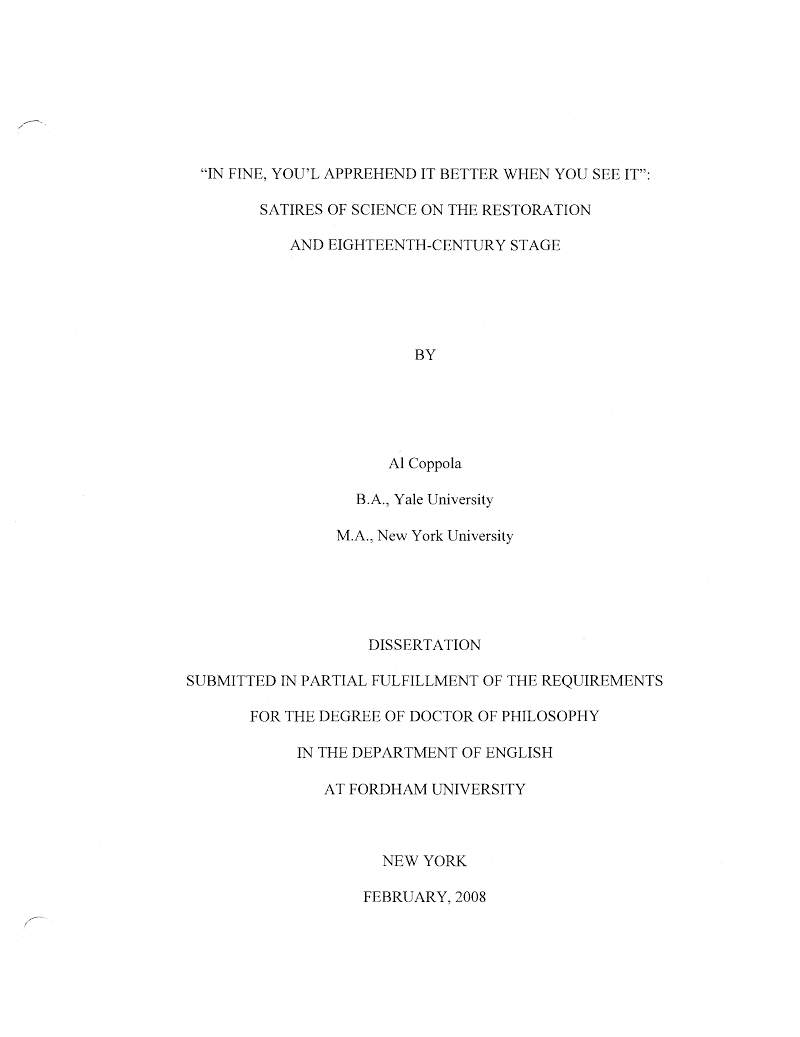
"In Fine, You'l Apprehend it Better when You See It": Satires of Science on the Restoration and Eighteenth-century Stage

"In Fine, You'l Apprehend it Better when You See It": Satires of Science on the Restoration and Eighteenth-century Stage

287 pages· 2008· ISBN 9780549469230
About
The line that I take for my title, spoken by Bayes in the Duke of Buckingham's The Rehearsal (1671/5), encapsulates the enthusiasm, hope and fear of a society transformed by its attention to what Thomas Sprat, in the Royal Society's first manifesto, called "things themselves"---the new focus of the New Science. My project centers on the familiar but little-studied satiric figure of the "virtuoso," the gentleman scientist who appears in plays throughout this period and serves as a lightning rod for a host of cultural anxieties. Satires of the virtuoso, I argue, are always talking about something else: the politics of the moment, the proper ordering of sexual and domestic roles, the dangers of irrational spectatorship, or the allure of allegedly useful "projects." My study probes the complex role played by natural philosophy in a culture that by was being transformed by the emergence of mass entertainment, popular science, incipient capitalism, and party politics. As the virtuoso natural philosophy of the Restoration gave way to the Newtonian "public science" of mid-century, theatrical satires of science focused attention on the political and economic appropriations of natural philosophy, but above all made visible the vexed role that spectacle played in the manufacture and dissemination of scientific truth. With chapters that analyze Thomas Shadwell's The Virtuoso (1676) and Thomas Durfey's Madam Fickle (1677); Aphra Behn's The Emperor of The Moon (1687), Nehemiah Grew's Musaeum Regalis Societatis (1685) and Exclusion Crisis political spectacles; John Gay, Alexander Pope and John Arbuthnot's Three Hours after Marriage (1717) and Susanna Centlivre's A Bold Stroke for a Wife (1718); and the Harlequin Doctor Faustus pantomimes (1723--4) and the popular Newtonian lectures, this project traces the rise and fall of virtuoso satire on stage in order to trace the far-reaching cultural effects of the seventeenth-century epistemic shift that privileged "matters of fact," a reformation of natural knowledge that was intended to drive out what Francis Bacon called the Idols of the Theatre, but which only drew science and the stage into closer relation.

Discuss "In Fine, You'l Apprehend it Better when You See It": Satires of Science on the Restoration and Eighteenth-century Stage with other readers

Join or start a book club for "In Fine, You'l Apprehend it Better when You See It": Satires of Science on the Restoration and Eighteenth-century Stage on Readfeed. Live chat, shared reading progress, and AI discussion questions — free to get started.

Frequently asked questions

How do I join a book club for "In Fine, You'l Apprehend it Better when You See It": Satires of Science on the Restoration and Eighteenth-century Stage?

Sign up free on Readfeed, then browse public clubs or start your own club with "In Fine, You'l Apprehend it Better when You See It": Satires of Science on the Restoration and Eighteenth-century Stage as the current read. Invite friends with a share link and discuss together with live chat and AI discussion questions.

Can I discuss "In Fine, You'l Apprehend it Better when You See It": Satires of Science on the Restoration and Eighteenth-century Stage with other readers online?

Yes. Readfeed book clubs let you chat live, share progress, and join discussions about "In Fine, You'l Apprehend it Better when You See It": Satires of Science on the Restoration and Eighteenth-century Stage with readers worldwide — whether your club is virtual, in-person, or hybrid.

Is Readfeed free?

Yes. Creating an account and joining book clubs is free. Sign up to find readers who love the same books and start discussing today.