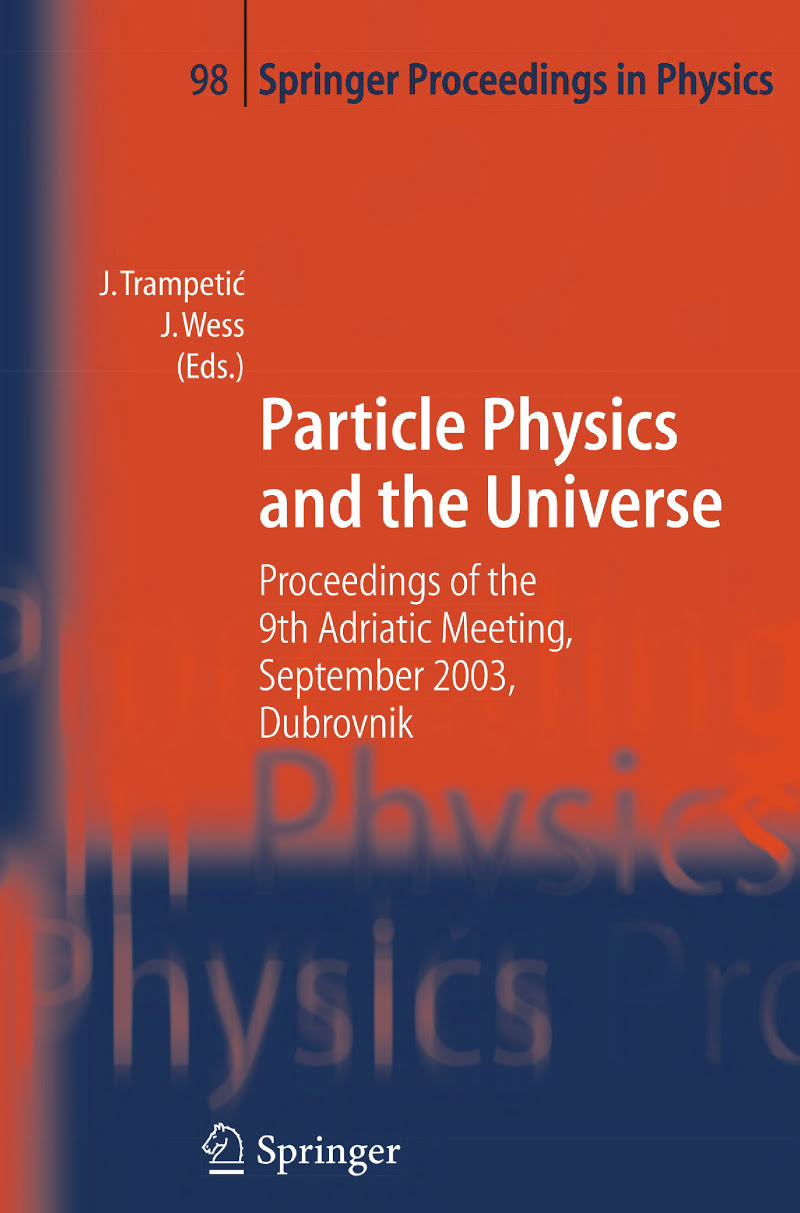
Particle Physics and the Universe

Particle Physics and the Universe

Proceedings of the 9th Adriatic meeting, Sept. 2003, Dubrovnik

by Julius Wess, Josip Trampetic

495 pages· 2006· ISBN 9783540267980
About
The Adriatic Meetings have traditionally been conferences on the most - vanced status of science. They are one of the very few conferences in physics aiming at a very broad participation of young and experienced researchers with di?erent backgrounds in particle physics. Particle physics has grown into a highly multi-faceted discipline over the sixty years of its existence, mainly because of two reasons: Particle physics as an experimental science is in need of large-scale laboratory set-ups, involving typically collaborations of several hundreds or even thousands of researchers and technicians with the most diverse expertise. This forces particle physics, being one of the most fundamental dis- plines of physics, to maintain a constant interchange and contact with other disciplines, notably solid-state physics and laser physics, cosmology and - trophysics, mathematical physics and mathematics. Since the expertise necessary in doing research in particle physics has become tremendously demanding in the last years, the ?eld tends to organize purely expert conferences, meetings and summer schools, such as for detector development, for astroparticle physics or for string theory. TheAdriaticMeetingthroughitsentirehistoryhasbeenaplaceforest- lishing exchange between theory and experiment. The 9th Adriatic Meeting successfully continued this tradition and even intensi?ed the cross-discipline communication by establishing new contacts between the community of c- mologists and of particle physicists. The exchange between theorists and - perimentalists was impressively intensive and will certainly have a lasting e?ect on several research projects of the European and world-wide physics community.

Discuss Particle Physics and the Universe with other readers

Join or start a book club for Particle Physics and the Universe on Readfeed. Live chat, shared reading progress, and AI discussion questions — free to get started.

Frequently asked questions

How do I join a book club for Particle Physics and the Universe?

Sign up free on Readfeed, then browse public clubs or start your own club with Particle Physics and the Universe as the current read. Invite friends with a share link and discuss together with live chat and AI discussion questions.

Can I discuss Particle Physics and the Universe with other readers online?

Yes. Readfeed book clubs let you chat live, share progress, and join discussions about Particle Physics and the Universe with readers worldwide — whether your club is virtual, in-person, or hybrid.

Is Readfeed free?

Yes. Creating an account and joining book clubs is free. Sign up to find readers who love the same books and start discussing today.