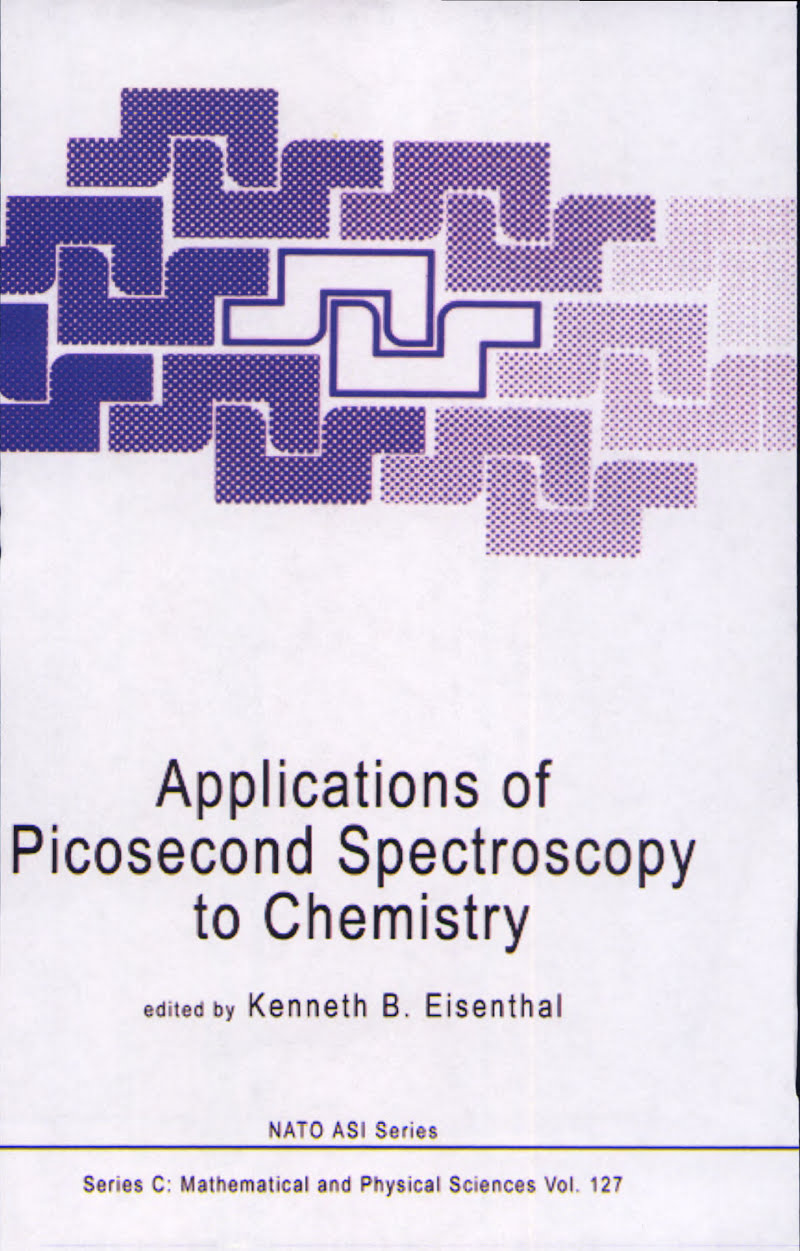
Applications of Picosecond Spectroscopy to Chemistry

Applications of Picosecond Spectroscopy to Chemistry

by K.B. Eisenthal

363 pages· 1984· ISBN 9789027717887
About
With the development of lasers that can generate light 11 14 pulses ranging from 10- - 10- sec duration, and capable of 13 peak powers in excess of 10 watts scientists have been able to investigate the interactions of light with matter in a time and power domain not previously possible. These ultrashort laser pulses provide a powerful tool for the study of chemical phenomena at the most fundamental level. Many of the elementary processes of importance in chemistry including energy dissipa tion, molecular motions, structural and chemical changes occur on a very short time scale and thus require special approaches. Th~ use of ultrashort laser pulses to perturb and to probe systems of interest affords a direct approach to the time reso lution of very rapid chemical phenomena. It was recognition of the impact of these relatively new approaches to chemical phenomena that motivated NATO to sponsor a meeting on the applications of picosecond spectroscopy in chemistry. The primary aim of the NATO workshop was to gain some perspective on the status of the field in terms of present research activities, technological developments and if possible the difficult task of sensing future directions. The way we decided to approach these issues was to gather together the main contributors to the field, fortunately many of whom were able to attend, to present their work and to participate in what turned out to be lively discussions of the field.

Discuss Applications of Picosecond Spectroscopy to Chemistry with other readers

Join or start a book club for Applications of Picosecond Spectroscopy to Chemistry on Readfeed. Live chat, shared reading progress, and AI discussion questions — free to get started.

Frequently asked questions

How do I join a book club for Applications of Picosecond Spectroscopy to Chemistry?

Sign up free on Readfeed, then browse public clubs or start your own club with Applications of Picosecond Spectroscopy to Chemistry as the current read. Invite friends with a share link and discuss together with live chat and AI discussion questions.

Can I discuss Applications of Picosecond Spectroscopy to Chemistry with other readers online?

Yes. Readfeed book clubs let you chat live, share progress, and join discussions about Applications of Picosecond Spectroscopy to Chemistry with readers worldwide — whether your club is virtual, in-person, or hybrid.

Is Readfeed free?

Yes. Creating an account and joining book clubs is free. Sign up to find readers who love the same books and start discussing today.