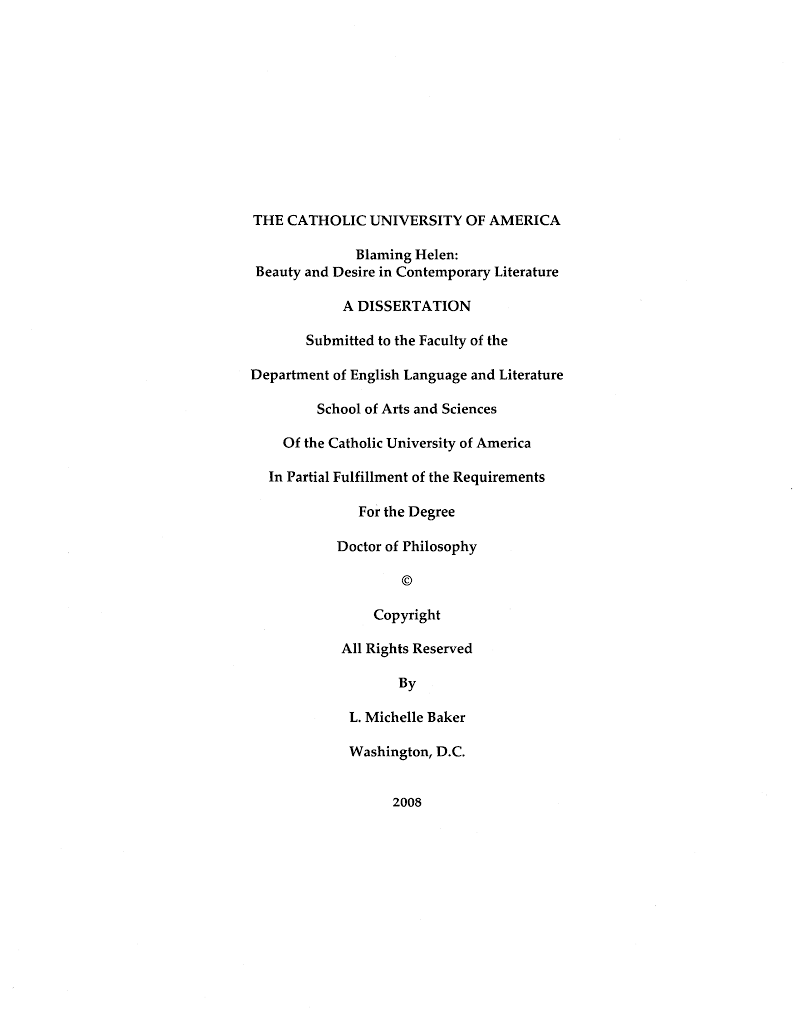
Blaming Helen: Beauty and Desire in Contemporary Literature

Blaming Helen: Beauty and Desire in Contemporary Literature

294 pages· 2008· ISBN 9780549955887
About
For more than thirty years, literary theory has been dominated by social critics and linguists while questions of the aesthetic are often marginalized. Using the symbol of Helen of Troy, this study suggests aesthetically viable ways of discussing both theory and literature. First reviewed are several manifestations of Helen from the classical era found in Homer, Gorgias, and Euripides, who demonstrate the essential nature of Helen's beauty, its autonomy, and its self-referential functioning. Chapters Two and Three examine idealist and materialist approaches to Helen posited by postmodern authors. The British novelist Hilary Bailey and the Greek poet Yannis Ritsos are studied as proponents of an idealistic aesthetic appalled by the power of Helen's form. Other postmodern authors including Valerio Manfredi, Barry Unsworth, and Christa Wolf confront the materiality of the aesthetic. Their conclusions are bleak, although Wolf suggests an ethics of personally responsible discourse rooted in the pull of the aesthetic that may circumvent some of the more destructive implications latent in the reality of symbols and sign systems. Her theory is confronted from a different angle in Chapter Four, where the libidinous aspects of Helen's beauty forge a potent talisman of the desire that motivates all human beings to individuation. To authors such as Elizabeth Cook, Mark Merlis, and Howard Barker, the physical beauty of a human form creates a longing for what Jacques Lacan describes as "the other," facilitating personal and cultural definition. In Derek Walcott's epic poem Omeros, human beauty is synonymous with the beauty of place. The aesthetic thus becomes temporal and ethereal. Thus are the essence, autonomy, and circularity of beauty first established during the classical era reasserted in the postmodern age in harmony with the positive (if tentative) social and personal implications outlined by Christa Wolf and Howard Barker. In analyzing these authors and their symbolic representations of Helen of Troy, this study demonstrates the range of attitudes toward beauty exhibited in the postmodern era, establishes a working theory of the relationships between beauty's material and transcendent properties, and introduces a framework in which further discussion of the aesthetic might be fostered.

Discuss Blaming Helen: Beauty and Desire in Contemporary Literature with other readers

Join or start a book club for Blaming Helen: Beauty and Desire in Contemporary Literature on Readfeed. Live chat, shared reading progress, and AI discussion questions — free to get started.

Frequently asked questions

How do I join a book club for Blaming Helen: Beauty and Desire in Contemporary Literature?

Sign up free on Readfeed, then browse public clubs or start your own club with Blaming Helen: Beauty and Desire in Contemporary Literature as the current read. Invite friends with a share link and discuss together with live chat and AI discussion questions.

Can I discuss Blaming Helen: Beauty and Desire in Contemporary Literature with other readers online?

Yes. Readfeed book clubs let you chat live, share progress, and join discussions about Blaming Helen: Beauty and Desire in Contemporary Literature with readers worldwide — whether your club is virtual, in-person, or hybrid.

Is Readfeed free?

Yes. Creating an account and joining book clubs is free. Sign up to find readers who love the same books and start discussing today.