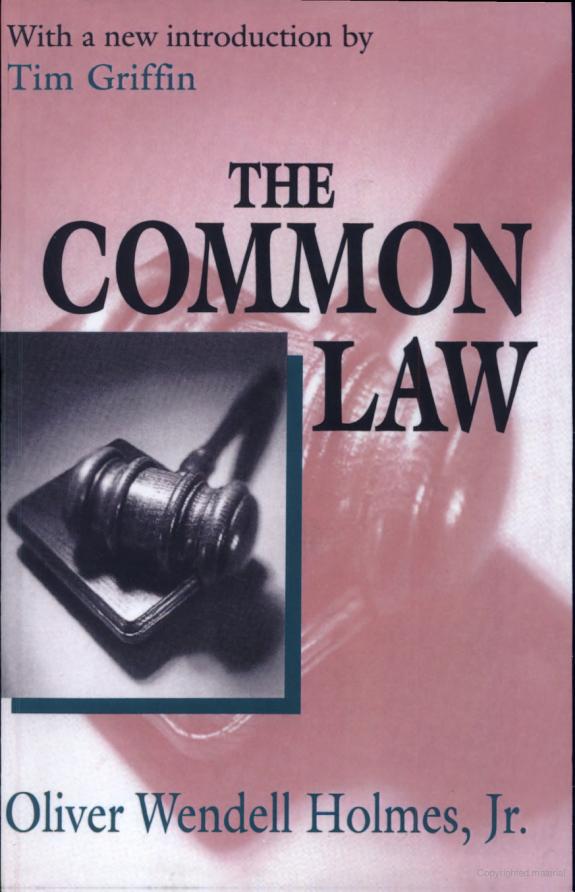
The Common Law
by Oliver Wendell Holmes
338 pages· 2004· ISBN 9781412819909
About
The Common Law is Oliver Wendell Holmes' most sustained work of jurisprudence. In it the careful reader will discern traces of his later thought as found in both his legal opinions and other writings. At the outset of The Common Law Holmes posits that he is concerned with establishing that the common law can meet the changing needs of society while preserving continuity with the past. A common law judge must be creative, both in determining the society's current needs, and in discerning how best to address these needs in a way that is continuous with past judicial decisions. In this way, the law evolves by moving out of its past, adapting to the needs of the present, and establishing a direction for the future. To Holmes' way of thinking, this approach is superior to imposing order in accordance with a philosophical position or theory because the law would thereby lose the flexibility it requires in responding to the needs and demands of disputing parties as well as society as a whole. According to Holmes, the social environment--the economic, moral, and political milieu--alters over time. Therefore, in order to remain responsive to this social environment, the law must change as well. But the law is also part of this environment and impacts it. There is, then, a continual reciprocity between the law and the social arrangements in which it is contextualized. And, as with the evolution of species, there is no starting over. Rather, in most cases, a judge takes existing legal concepts and principles, as these have been memorialized in legal precedent, and adapts them, often unconsciously, to fit the requirements of a particular case and present social conditions. Oliver Wendell Holmes, Jr. (1841-1935) served as chief justice of the Massachusetts Supreme Court and as an associate justice of the U.S. Supreme Court. He was nicknamed the "Great Dissenter" because of his many dissenting opinions. Holmes is also the author of Kent's Commentaries on the Law (1873) and "The Path of the Law" (1897). Tim Griffin has advanced degrees in philosophy and law, and has taught philosophy and legal theory courses at a number of universities. He is currently a seminarian pursuing ordination to the priesthood in the Episcopal Church.
Discuss The Common Law with other readers
Join or start a book club for The Common Law on Readfeed. Live chat, shared reading progress, and AI discussion questions — free to get started.
Frequently asked questions
How do I join a book club for The Common Law?
Sign up free on Readfeed, then browse public clubs or start your own club with The Common Law as the current read. Invite friends with a share link and discuss together with live chat and AI discussion questions.
Can I discuss The Common Law with other readers online?
Yes. Readfeed book clubs let you chat live, share progress, and join discussions about The Common Law with readers worldwide — whether your club is virtual, in-person, or hybrid.
Is Readfeed free?
Yes. Creating an account and joining book clubs is free. Sign up to find readers who love the same books and start discussing today.