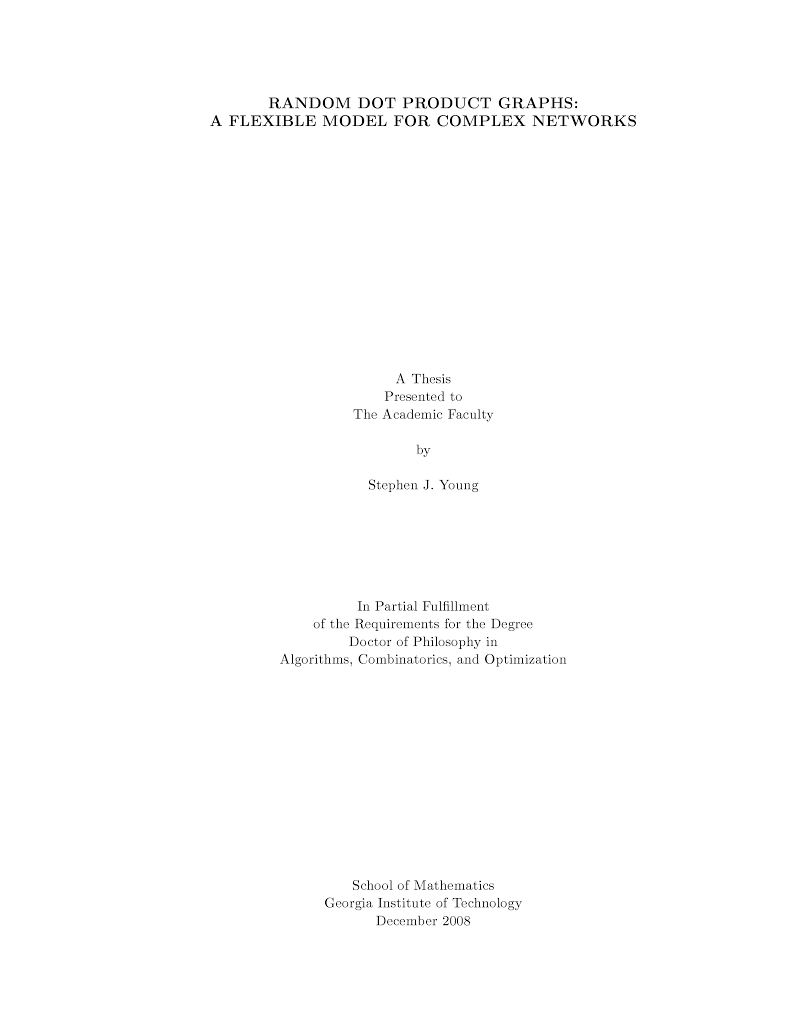
Random Dot Product Graphs: A Flexible Model for Complex Networks

Random Dot Product Graphs: A Flexible Model for Complex Networks

73 pages· 2008· ISBN 9781109012637
About
Over the last twenty years, as biological, technological, and social networks have risen in prominence and importance, the study of complex networks has attracted researchers from a wide range of fields. As a result, there is a large and diverse body of literature concerning the properties and development of models for complex networks. However, many of the models that have been previously developed, although quite successful at capturing many observed properties of complex networks, have failed to capture the fundamental semantics of the networks. In this thesis, we propose a robust and general model for complex networks that incorporates at a fundamental level semantic information. We show that for a large range of average degrees and with a suitable choice of parameters, this model exhibits the three hallmark properties of complex networks: small diameter, clustering, and skewed degree distribution. Additionally, we provide a structural interpretation of assortativity and apply this structural assortativity to the random dot product graph model. We also extend the results of Chung, Lu, and Vu on the spectral gap of the expected degree sequence model to a general class of random graph models with independent edges. We apply this result to the recently developed Stochastic Kronecker graph model of Leskovec, Chakrabarti, Kleinberg, and Faloutsos.

Discuss Random Dot Product Graphs: A Flexible Model for Complex Networks with other readers

Join or start a book club for Random Dot Product Graphs: A Flexible Model for Complex Networks on Readfeed. Live chat, shared reading progress, and AI discussion questions — free to get started.

Frequently asked questions

How do I join a book club for Random Dot Product Graphs: A Flexible Model for Complex Networks?

Sign up free on Readfeed, then browse public clubs or start your own club with Random Dot Product Graphs: A Flexible Model for Complex Networks as the current read. Invite friends with a share link and discuss together with live chat and AI discussion questions.

Can I discuss Random Dot Product Graphs: A Flexible Model for Complex Networks with other readers online?

Yes. Readfeed book clubs let you chat live, share progress, and join discussions about Random Dot Product Graphs: A Flexible Model for Complex Networks with readers worldwide — whether your club is virtual, in-person, or hybrid.

Is Readfeed free?

Yes. Creating an account and joining book clubs is free. Sign up to find readers who love the same books and start discussing today.