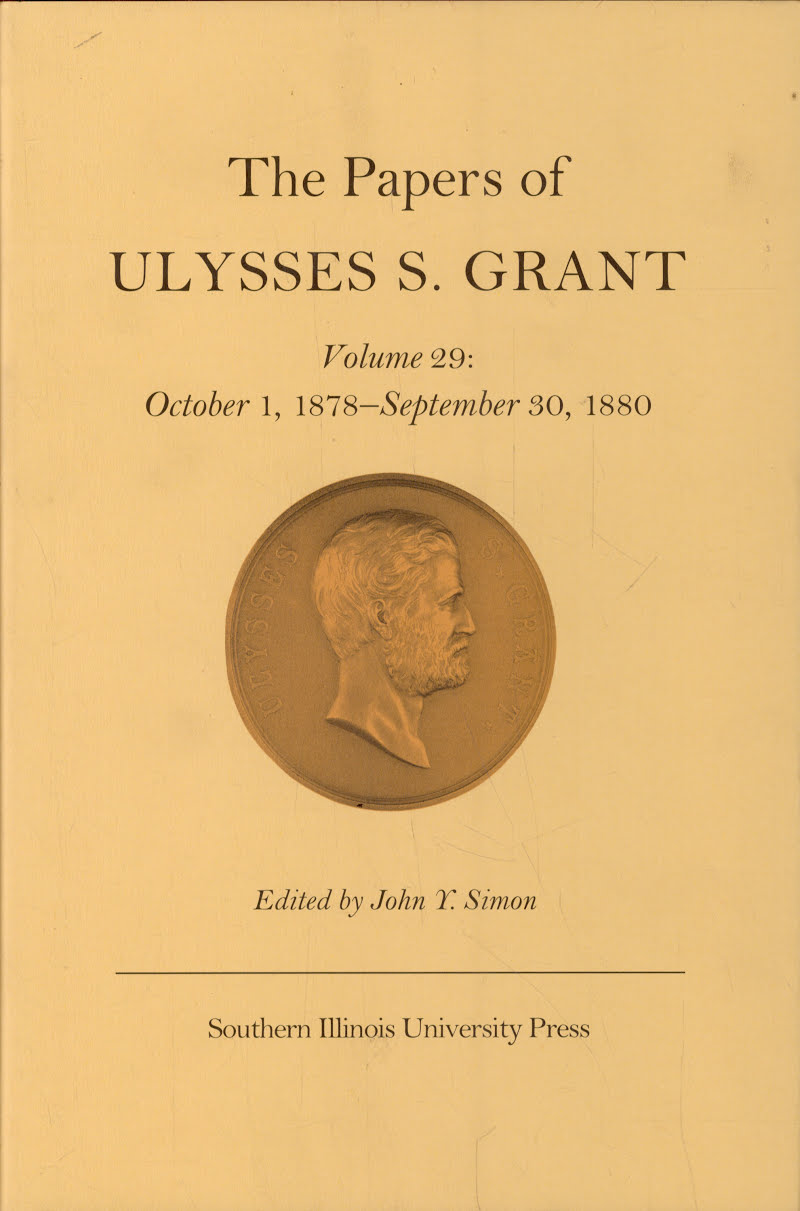
By late 1878, after a year and a half abroad, Ulysses S. Grant had visited every country in Europe, and he was homesick. "I have seen nothing to make me regret that I am an American. Our country: its resources; energy, inginuity and intelligence of the people, &c. is more appreciated abroad than at home.” Grant decided to return through Asia. After "a delightful run” to Dublin and northern Ireland, he left Paris with his wife Julia, son Frederick, and a few friends in January, 1879. Heading east, Grant kept a travel diary. On the voyage to Bombay, travelers socialized on deck. "Four of the lady passengers and one of the gentlemen Amature Artists, amused themselves by sketching me.” Crossing India overland, the Grant party rode elephants, visited the Taj Mahal, and witnessed Hindu ceremonies. From Calcutta, Grant sailed for Burma, Singapore, and Siam, where he found young King Chulalongkorn "quite impressive in appearance and intelligent.” After stops at Hong Kong and Canton, Grant wrote: "I am satisfied that the Chinese are badly treated at home by europeans as well as when they emigrate.” At Tientsin, Grant befriended Viceroy Li Hung-chang, "probably the most intelligent and most advanced ruler--if not man--in China,” and at Peking he agreed to mediate a dispute with Japan over the Ryukyu Islands. While China languished, Japan had made "almost inconceivable” progress since the 1868 Meiji Restoration. During a "very delightful” ten weeks, Grant met the Emperor, visited shrines and hot springs, attended a play and a lantern parade in his honor, and held talks on the Ryukyu dispute. He departed "with assurances that pleasant recollections of my present visit will not vanish while my life lasts.” Throngs welcomed Grant to San Francisco on September 20, 1879. Grant assured all that the United States stood second to none in the world in its people, institutions, and ideals. He told Confederate veterans: "I have an abiding faith that we will remain together in future harmony.” Grant toured Yosemite and visited scenes from his army days in Oregon and Washington Territory, then headed east again, his train cheered at every stop. At Galena and Chicago he basked in the warmth of ovations and old friends. Another series of crowds and banquets culminated in December at Philadelphia, where Grant completed his circuit of the globe. As 1880 began, Grant headed south. He marveled at Florida's potential and groused at Cuba's heat, then reached Mexico, a country he had long ago admired as part of an occupying army. "The climate is perfection, the scenery unsurpassed and the people as clever and hospitable as it is possible for them to be.” Grant met influential leaders, toured silver mines and old battlefields, and encouraged development. Grant returned to New Orleans and more banquets and speeches, touting reconciliation and praising black advancement. His progress north took on the air of a campaign as the Republican convention loomed. Newspapers debated a third term while Grant kept silent. In June, at Chicago, delegates split between Grant and James G. Blaine, and settled on dark horse James A. Garfield. Grant expressed relief at avoiding a "most violent campaign.” Grant spent the summer in the Rocky Mountains inspecting mines, sometimes by pack mule, for possible investments. In September, back in Galena, he rejoined the political fray, attacking Garfield's opponent, Major General Winfield S. Hancock, in an interview. "He is the most selfish man I know.... He can not bear to hear anyone else praised, but can take any amount of flattery.” With the election weeks away, and the outcome in doubt, Grant took to the stump. "I am a Republican,” he told an Ohio crowd, "as the two great political parties are now divided, because the Republican Party is a national party seeking the greatest good for the greatest number of citizens.”