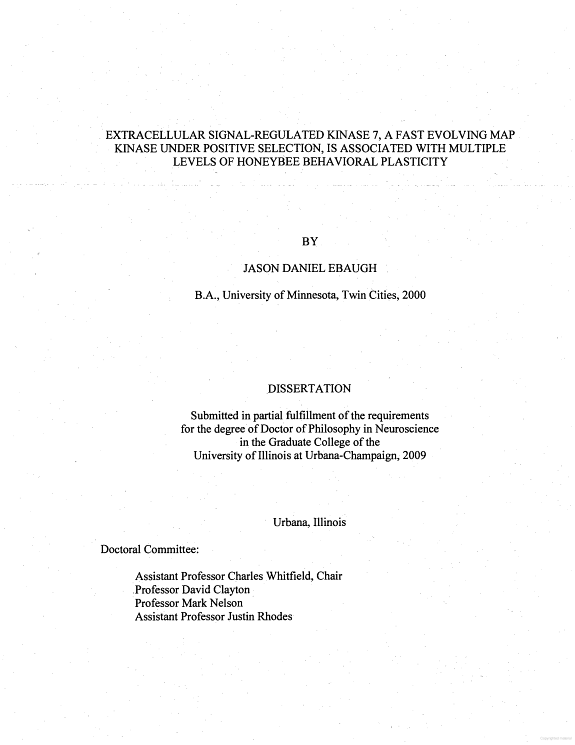
Extracellular Signal-regulated Kinase 7, a Fast Evolving Map Kinase Under Positive Selection, is Associated with Multiple Levels of Honeybee Behavioral Plasticity

Extracellular Signal-regulated Kinase 7, a Fast Evolving Map Kinase Under Positive Selection, is Associated with Multiple Levels of Honeybee Behavioral Plasticity

by Jason Daniel Ebaugh

114 pages· 2009· ISBN 9781109217711
About
Extra cellular response kinase 7 (Erk7) is a mitogen-activated protein kinase. Studying behavioral plasticity in honeybees led to my initial interest in Erk7. A previous gene expression profiling study implicated Erk7 as a candidate gene in honeybee behavioral plasticity. My work has built upon and extended these initial findings. Honey bee workers exhibit a hierarchical organization of behavioral plasticity in which long-duration, age-related and socially modulated states are characterized by specific repertoires of short-duration behaviors. Young workers (hive bees) perform tasks at the hive center including brood-care (nursing) and leave the hive for short training (orientation) flights. Older workers (foragers) collect water, nectar and pollen to provision the hive. Erk7 protein regulation is associated both with long-duration behavioral state, and with specific, short-duration behavior. Erk7 protein occurs in the bee brain in phosphorylated form and has an additional modification that is susceptible to N-glycanase. I have demonstrated that Erk7 is expressed throughout the honeybee brain. Light and vision are important components of honeybee behavioral plasticity. Therefore, I tested the hypothesis that the optic-lobes are the location of the circuitry in which behaviorally associated regulation of Erk7 is occurring. I found that the optic lobes are not the location of behaviorally associated regulation of Erk7. Additionally, I have shown that Erk7 is a rapidly evolving Map kinase which is under positive selection in the Drosophila and mammalian lineages. Hence Erk7, a gene associated with behavioral plasticity in individual honeybees, also underlies evolutionary plasticity in diverse lineages.

Discuss Extracellular Signal-regulated Kinase 7, a Fast Evolving Map Kinase Under Positive Selection, is Associated with Multiple Levels of Honeybee Behavioral Plasticity with other readers

Join or start a book club for Extracellular Signal-regulated Kinase 7, a Fast Evolving Map Kinase Under Positive Selection, is Associated with Multiple Levels of Honeybee Behavioral Plasticity on Readfeed. Live chat, shared reading progress, and AI discussion questions — free to get started.

Frequently asked questions

How do I join a book club for Extracellular Signal-regulated Kinase 7, a Fast Evolving Map Kinase Under Positive Selection, is Associated with Multiple Levels of Honeybee Behavioral Plasticity?

Sign up free on Readfeed, then browse public clubs or start your own club with Extracellular Signal-regulated Kinase 7, a Fast Evolving Map Kinase Under Positive Selection, is Associated with Multiple Levels of Honeybee Behavioral Plasticity as the current read. Invite friends with a share link and discuss together with live chat and AI discussion questions.

Can I discuss Extracellular Signal-regulated Kinase 7, a Fast Evolving Map Kinase Under Positive Selection, is Associated with Multiple Levels of Honeybee Behavioral Plasticity with other readers online?

Yes. Readfeed book clubs let you chat live, share progress, and join discussions about Extracellular Signal-regulated Kinase 7, a Fast Evolving Map Kinase Under Positive Selection, is Associated with Multiple Levels of Honeybee Behavioral Plasticity with readers worldwide — whether your club is virtual, in-person, or hybrid.

Is Readfeed free?

Yes. Creating an account and joining book clubs is free. Sign up to find readers who love the same books and start discussing today.