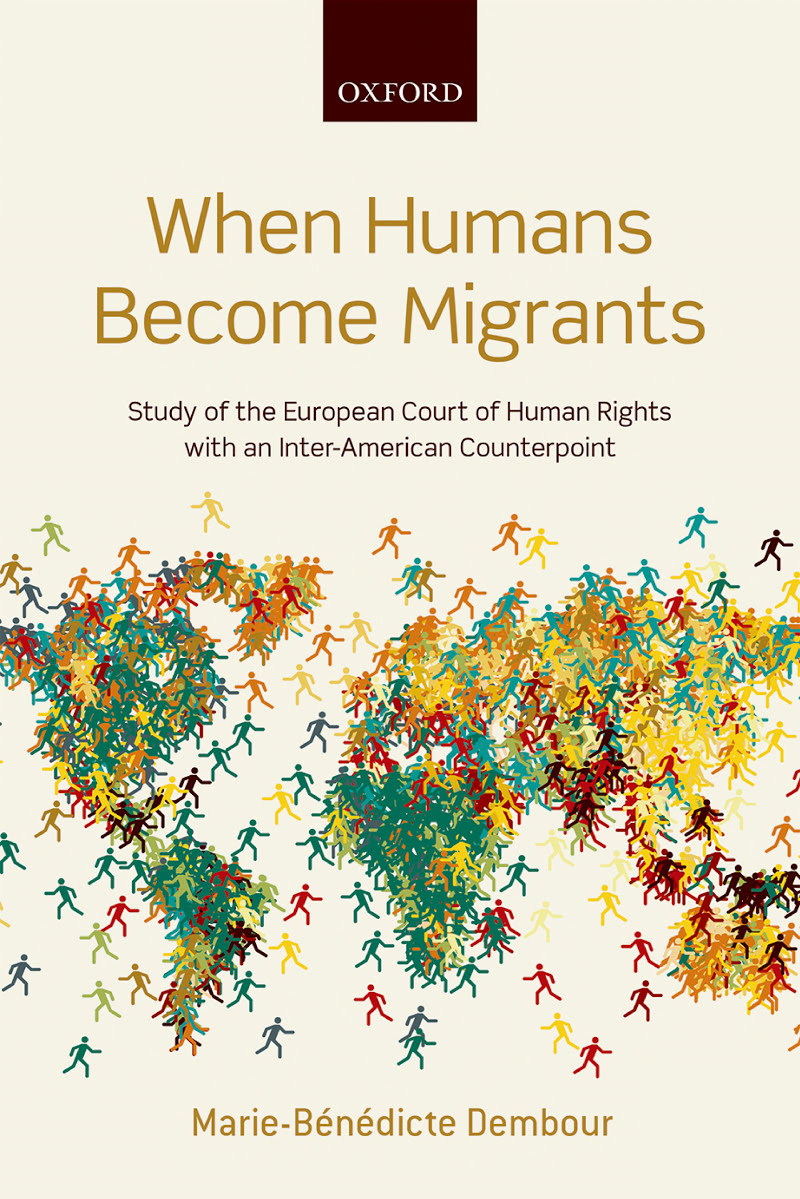
When Humans Become Migrants

When Humans Become Migrants

Study of the European Court of Human Rights with an Inter-American Counterpoint

by Marie-Bénédicte Dembour

575 pages· 2015· ISBN 9780199667833
About
The treatment of migrants is one of the most challenging issues that human rights, as a political philosophy, faces today. It has increasingly become a contentious issue for many governments and international organizations around the world. The controversies surrounding immigration can lead to practices at odds with the ethical message embodied in the concept of human rights, and the notion of 'migrants' as a group which should be treated in a distinct manner. This book examines the way in which two institutions tasked with ensuring the protection of human rights, the European Court of Human Rights and Inter-American Court of Human Rights, treat claims lodged by migrants. It combines legal, sociological, and historical analysis to show that the two courts were the product of different backgrounds, which led to differing attitudes towards migrants in their founding texts, and that these differences were reinforced in their developing case law. The book assesses the case law of both courts in detail to argue that they approach migrant cases from fundamentally different perspectives. It asserts that the European Court of Human Rights treats migrants first as aliens, and then, but only as a second step in its reasoning, as human beings. By contrast, the Inter-American Court of Human Rights approaches migrants first as human beings, and secondly as foreigners (if they are). Dembour argues therefore that the Inter-American Court of Human Rights takes a fundamentally more human rights-driven approach to this issue. The book shows how these trends formed at the courts, and assesses whether their approaches have changed over time. It also assesses in detail the issue of the detention of irregular migrants. Ultimately it analyses whether the divergence in the case law of the two courts is likely to continue, or whether they could potentially adopt a more unified practice.

Discuss When Humans Become Migrants with other readers

Join or start a book club for When Humans Become Migrants on Readfeed. Live chat, shared reading progress, and AI discussion questions — free to get started.

Frequently asked questions

How do I join a book club for When Humans Become Migrants?

Sign up free on Readfeed, then browse public clubs or start your own club with When Humans Become Migrants as the current read. Invite friends with a share link and discuss together with live chat and AI discussion questions.

Can I discuss When Humans Become Migrants with other readers online?

Yes. Readfeed book clubs let you chat live, share progress, and join discussions about When Humans Become Migrants with readers worldwide — whether your club is virtual, in-person, or hybrid.

Is Readfeed free?

Yes. Creating an account and joining book clubs is free. Sign up to find readers who love the same books and start discussing today.