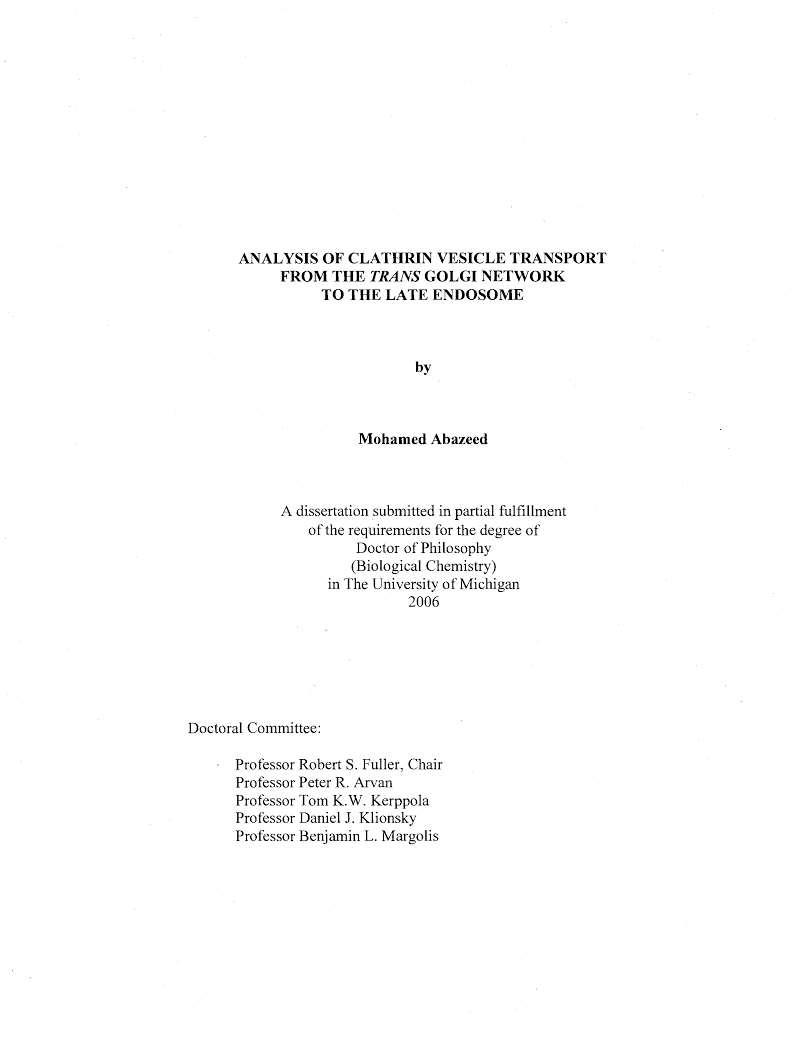
Analysis of Clathrin Vesicle Transport from the Trans Golgi Network to the Late Endosome

Analysis of Clathrin Vesicle Transport from the Trans Golgi Network to the Late Endosome

174 pages· 2008· ISBN 9780549511557
About
Vesicle transport from the trans-Golgi network (TGN) to the late endosome/prevacuolar compartment (PVC) represents a conserved, clathrin-dependent sorting event that separates lysosomal from secretory cargo molecules and is also required for localization of integral membrane proteins to the TGN. The principal aim of this thesis has been the development of a cell-free assay that authentically reconstitutes the transport of membrane proteins from the TGN to the late endosome/PVC. The cell-free reaction exhibits features consistent with authentic membrane fusion reactions including dependence on time, temperature, ATP, and cytosol. Molecular analysis indicates that factors required for formation of clathrin-coated vesicles at the TGN (the Chc1p clathrin heavy chain, the Vps1p dynamin homolog, the Gga clathrin adaptor) and for vesicle fusion at the PVC (the Pep12p t-SNARE, the Vps21p rab protein, the Vps45p SM (Sec1/Munc18) protein) are required for cell-free transport. We used the TGN-PVC transport assay to determine the roles of clathrin adaptors Gga and AP-1 in TGN-PVC transport. We find that the Gga1/2 proteins, and not AP-1, function in the direct transport of two TGN transmembrane proteins, Kex2p and Vps10p, from the TGN to the PVC. To characterize the role of the yeast Gga proteins in TGN to PVC transport, we employ directed yeast two-hybrid and in vitro binding experiments to identify interactions between the sequences in the C-tails of TGN cargo molecules and Gga1/2p. Together, these experiments demonstrate that sequences in the cytosolic tails of Kex2p and Vps10p bind to the VHS domain of the Gga1/2p adaptor. Details of these experiments as well as further studies directed toward identifying the binding regions that mediate these interactions are described. Finally, we show that truncated forms of Gga proteins are able to form homo- and hetero-dimers and that sequence elements in the Gga hinge domain function to block both cargo binding and dimer formation. All together, these results establish the first cell-free assay reconstitution of TGN to late endosome/PVC transport in any system and describe new insights into the process of molecular recruitment of cargo proteins into Gga-containing clathrin coated vesicles at the TGN.

Discuss Analysis of Clathrin Vesicle Transport from the Trans Golgi Network to the Late Endosome with other readers

Join or start a book club for Analysis of Clathrin Vesicle Transport from the Trans Golgi Network to the Late Endosome on Readfeed. Live chat, shared reading progress, and AI discussion questions — free to get started.

Frequently asked questions

How do I join a book club for Analysis of Clathrin Vesicle Transport from the Trans Golgi Network to the Late Endosome?

Sign up free on Readfeed, then browse public clubs or start your own club with Analysis of Clathrin Vesicle Transport from the Trans Golgi Network to the Late Endosome as the current read. Invite friends with a share link and discuss together with live chat and AI discussion questions.

Can I discuss Analysis of Clathrin Vesicle Transport from the Trans Golgi Network to the Late Endosome with other readers online?

Yes. Readfeed book clubs let you chat live, share progress, and join discussions about Analysis of Clathrin Vesicle Transport from the Trans Golgi Network to the Late Endosome with readers worldwide — whether your club is virtual, in-person, or hybrid.

Is Readfeed free?

Yes. Creating an account and joining book clubs is free. Sign up to find readers who love the same books and start discussing today.