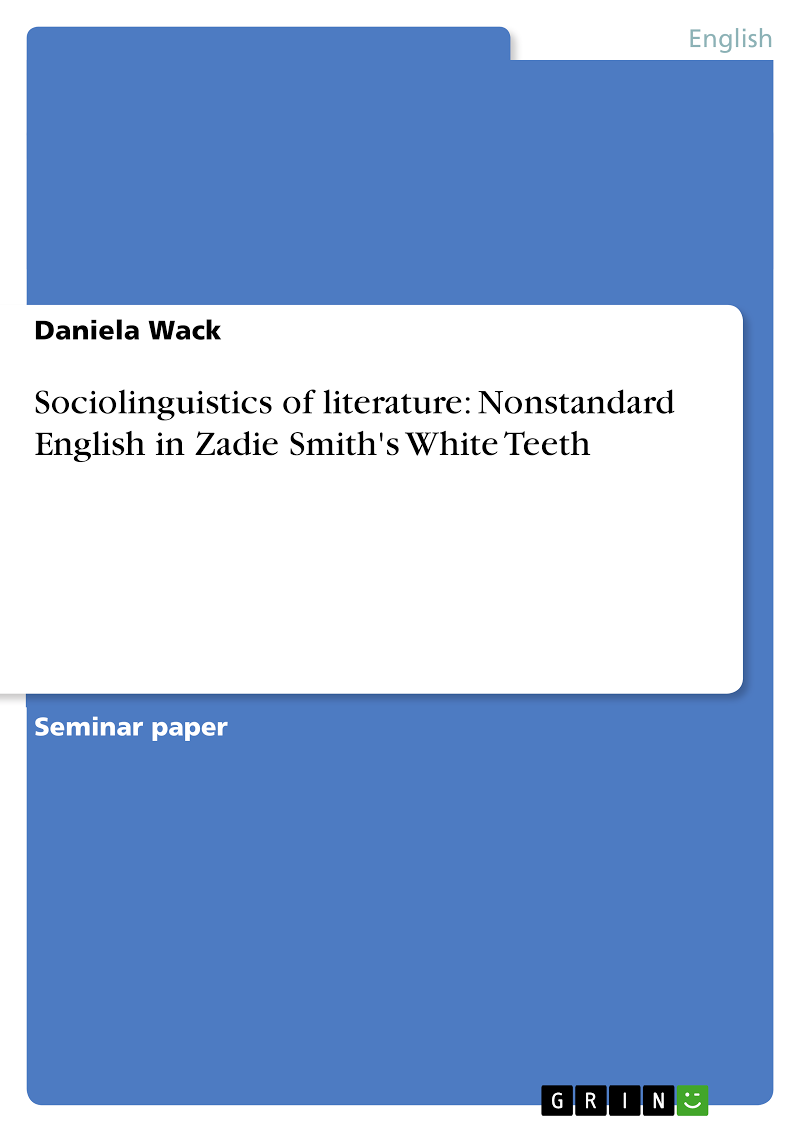
Sociolinguistics of literature: Nonstandard English in Zadie Smith's White Teeth

Sociolinguistics of literature: Nonstandard English in Zadie Smith's White Teeth

by Daniela Wack

20 pages· 2006· ISBN 9783638540643
About
Seminar paper from the year 2005 in the subject English Language and Literature Studies - Linguistics, grade: 1,0, University of Freiburg, 20 entries in the bibliography, language: English, abstract: White Teethhas widely been celebrated as one of the best multicultural novels in recent years. The Whitbread judging panel called it a “landmark novel for multicultural Britain, as well as a superb portrait of contemporary London.”. Claire Squires notes that the voicing of different characters and their ethnic group is one of the most apparent feature of White Teeth. From Archie’s bumbling homilies to the “appalling pronunciation” of the customers Samad takes orders from in the restaurant, from Alsana's wacky images to the hybrid street slang of the “Raggastani,” and from Irie’s rising, soap-opera influenced, Antipodean intonation to her accusation that Millat’s Caribbean-toned speech is “not your voice”. You sound ridiculous!” Smith displays a finelytuned ear for linguistic inflections and their sociocultural nuances. This paper takes a look at these “linguistic inflections and their sociocultural nuances” and analyses various varieties of English that are employed in the novel. The main concern, however, is not the description of nonstandard varieties, but the question if these varieties are realistically represented with regard London’s linguistic landscape. In other words, in how far can nonstandard language in fiction be taken as a reliable source for a sociolinguistic analysis? For this purpose, various examples of direct speech as well narrative comments will be compared with real language use. The paper is structured as follows. Starting with a chapter on literary sociolinguistic, I will discuss the conditions and problems that have to be taken into consideration when taking fiction as a source for sociolinguistic research. Then, I will reflect on different approaches in sociolinguistics that are important for the study of nonstandard language that represents ethnic, regional, social and age-related variation. In the major part of this paper, the different nonstandard English varieties that appear inWhite Teeth,such as Cockney, youth language, and Jamaican Creole, as well as language crossing, will be analysed and compared to sociolinguistic studies. The use of Bengali in White Teethhas to be omitted as the study of a language of its own would go beyond the scope of this paper. In my analysis I will also reveal the semiotic and symbolic potential of the literary nonstandard varieties in comparison to their representation in reality.

Discuss Sociolinguistics of literature: Nonstandard English in Zadie Smith's White Teeth with other readers

Join or start a book club for Sociolinguistics of literature: Nonstandard English in Zadie Smith's White Teeth on Readfeed. Live chat, shared reading progress, and AI discussion questions — free to get started.

Frequently asked questions

How do I join a book club for Sociolinguistics of literature: Nonstandard English in Zadie Smith's White Teeth?

Sign up free on Readfeed, then browse public clubs or start your own club with Sociolinguistics of literature: Nonstandard English in Zadie Smith's White Teeth as the current read. Invite friends with a share link and discuss together with live chat and AI discussion questions.

Can I discuss Sociolinguistics of literature: Nonstandard English in Zadie Smith's White Teeth with other readers online?

Yes. Readfeed book clubs let you chat live, share progress, and join discussions about Sociolinguistics of literature: Nonstandard English in Zadie Smith's White Teeth with readers worldwide — whether your club is virtual, in-person, or hybrid.

Is Readfeed free?

Yes. Creating an account and joining book clubs is free. Sign up to find readers who love the same books and start discussing today.