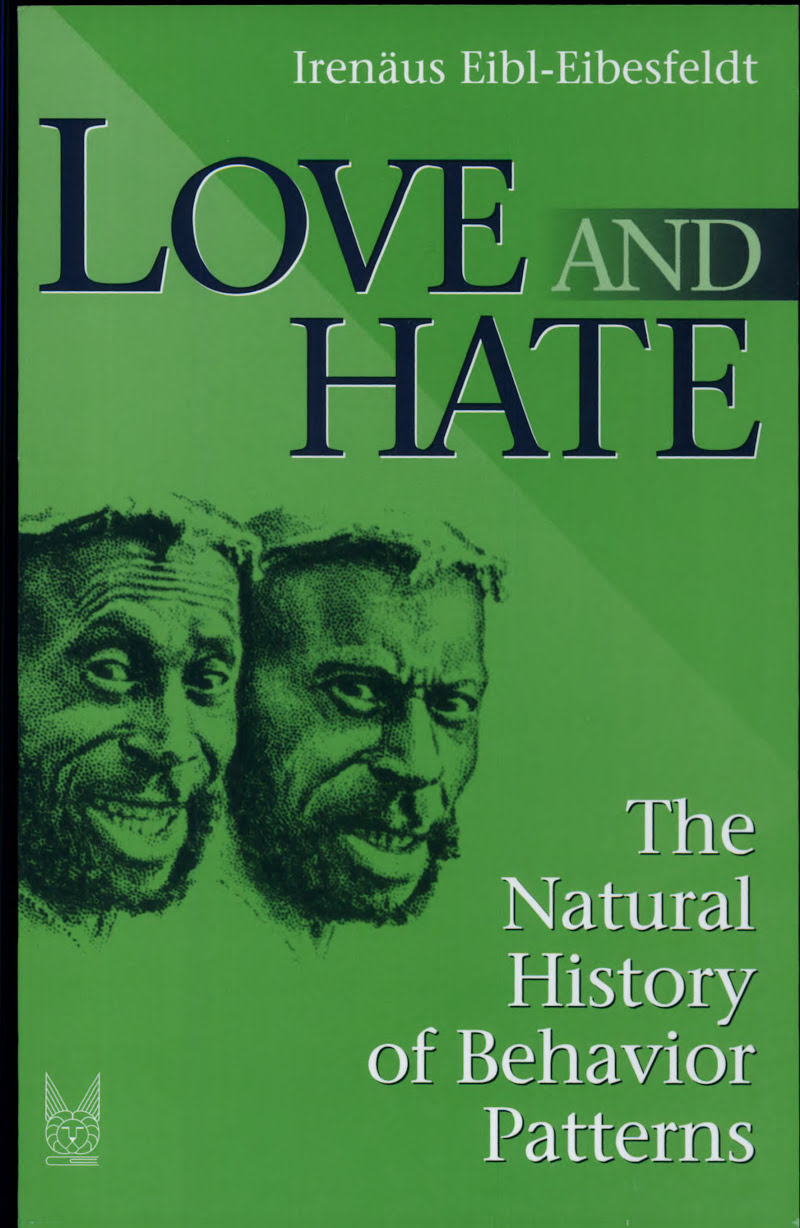
Love and Hate
On the Natural History of Basic Behaviour Patterns
by Irenäus Eibl-Eibesfeldt
276 pages· 1973· ISBN 9781412849937
About
The author argues that there are specific turning points in evolution. Structures and behavioral patterns that evolved in the service of discrete functions sometimes allow for unforeseen new developments as a side effect. In retrospect, they have proven to be pre-adaptations, and serve as raw material for natural selection to work upon. "Love and Hate" was intended to complement Konrad Lorenz's book, "On Aggression," by pointing out our motivations to provide nurturing, and thus to counteract and correct the widespread but one-sided opinion that biologists always present nature as bloody in tooth and claw and intra-specific aggression as the prime mover of evolution. This simplistic image is, nonetheless, still with us, all the more regrettably because it hampers discussion across scholarly disciplines. Eibl-Eibesfeldt argues that leaders in individualized groups are chosen for their pro-social abilities. Those who comfort group members in distress, who are able to intervene in quarrels and to protect group members who are attacked, those who share, those who, in brief, show abilities to nurture, are chosen by the others as leaders, rather than those who use their abilities in competitive ways. Of course, group leaders may need, beyond their pro-social competence, to be gifted as orators, war leaders, or healers. Issues of love and hate are social in origin and hence social in consequence. Life has emerged on this planet in a succession of new forms, from the simplest algae to man--man the one being who reflects upon this creation, who seeks to fashion it himself and who, in the process, may end by destroying it. It would indeed be grotesque if the question of the meaning of life were to be solved in this way. As the author notes in the preface of this new edition: "I discuss the phylogenetic origin of our behavior and motivations, which provide the basis for our cultural evolution and thus for our humanitarian hopes." In language that is clear and accessible throughout, arguing forcefully for the innate and "preprogrammed" dispositions of behavior in higher vertebrates, including humans, Eibl-Eibesfeldt steers a middle course in discussing the development of cultural and ethical norms while insisting on their matrix of biological origins.
Discuss Love and Hate with other readers
Join or start a book club for Love and Hate on Readfeed. Live chat, shared reading progress, and AI discussion questions — free to get started.
Frequently asked questions
How do I join a book club for Love and Hate?
Sign up free on Readfeed, then browse public clubs or start your own club with Love and Hate as the current read. Invite friends with a share link and discuss together with live chat and AI discussion questions.
Can I discuss Love and Hate with other readers online?
Yes. Readfeed book clubs let you chat live, share progress, and join discussions about Love and Hate with readers worldwide — whether your club is virtual, in-person, or hybrid.
Is Readfeed free?
Yes. Creating an account and joining book clubs is free. Sign up to find readers who love the same books and start discussing today.