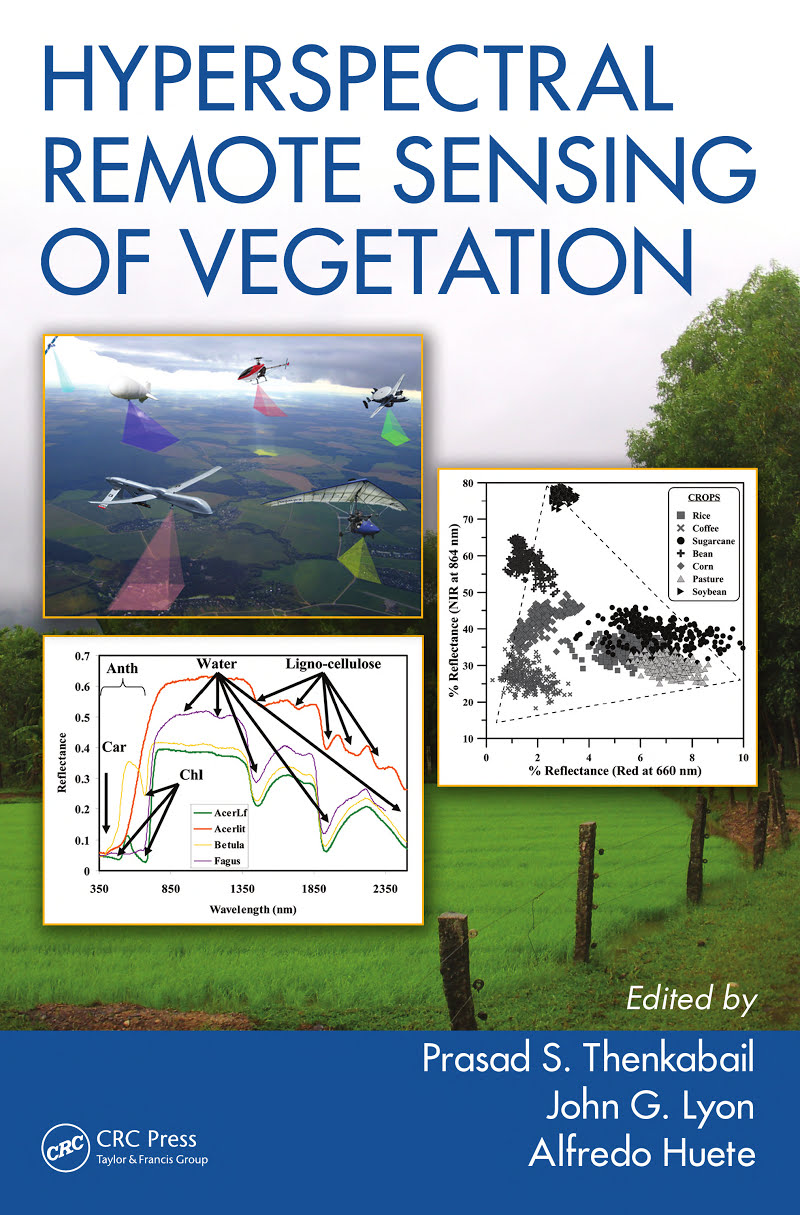
Hyperspectral narrow-band (or imaging spectroscopy) spectral data are fast emerging as practical solutions in modeling and mapping vegetation. Recent research has demonstrated the advances in and merit of hyperspectral data in a range of applications including quantifying agricultural crops, modeling forest canopy biochemical properties, detecting crop stress and disease, mapping leaf chlorophyll content as it influences crop production, identifying plants affected by contaminants such as arsenic, demonstrating sensitivity to plant nitrogen content, classifying vegetation species and type, characterizing wetlands, and mapping invasive species. The need for significant improvements in quantifying, modeling, and mapping plant chemical, physical, and water properties is more critical than ever before to reduce uncertainties in our understanding of the Earth and to better sustain it. There is also a need for a synthesis of the vast knowledge spread throughout the literature from more than 40 years of research. Hyperspectral Remote Sensing of Vegetation integrates this knowledge, guiding readers to harness the capabilities of the most recent advances in applying hyperspectral remote sensing technology to the study of terrestrial vegetation. Taking a practical approach to a complex subject, the book demonstrates the experience, utility, methods and models used in studying vegetation using hyperspectral data. Written by leading experts, including pioneers in the field, each chapter presents specific applications, reviews existing state-of-the-art knowledge, highlights the advances made, and provides guidance for the appropriate use of hyperspectral data in the study of vegetation as well as its numerous applications, such as crop yield modeling, crop and vegetation biophysical and biochemical property characterization, and crop moisture assessment. This comprehensive book brings together the best global expertise on hyperspectral remote sensing of agriculture, crop water use, plant species detection, vegetation classification, biophysical and biochemical modeling, crop productivity and water productivity mapping, and modeling. It provides the pertinent facts, synthesizing findings so that readers can get the correct picture on issues such as the best wavebands for their practical applications, methods of analysis using whole spectra, hyperspectral vegetation indices targeted to study specific biophysical and biochemical quantities, and methods for detecting parameters such as crop moisture variability, chlorophyll content, and stress levels. A collective "knowledge bank," it guides professionals to adopt the best practices for their own work.