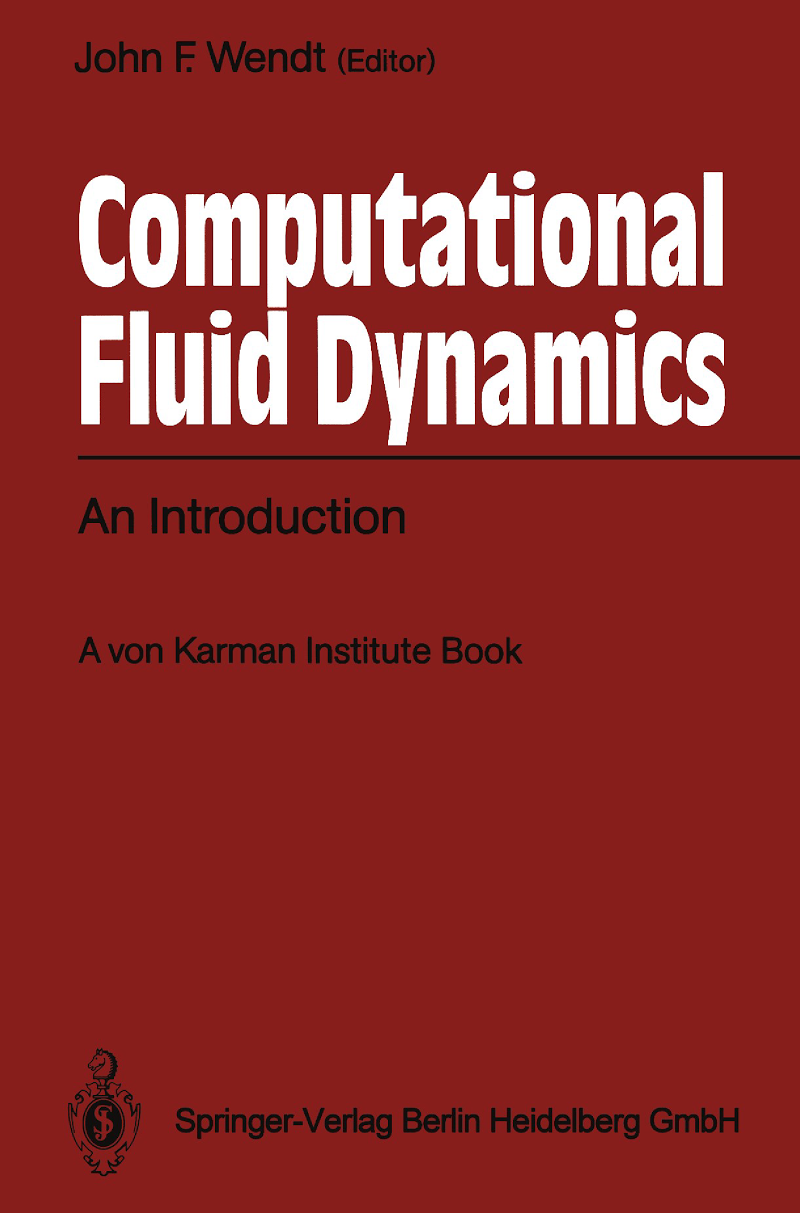
Computational Fluid Dynamics
An Introduction
by John Wendt
291 pages· 2013· ISBN 9783662113509
About
This book is an outgrowth of a von Kannan Institute Lecture Series by the same title first presented in 1985 and repeated with modifications in succeeding years. The objective, then and now, was to present the subject of computational fluid dynamics (CFD) to an audience unfamiliar with all but the most basic aspects of numerical techniques and to do so in such a way that the practical application ofCFD would become clear to everyone. Remarks from hundreds of persons who followed this course encouraged the editor and the authors to improve the content and organization year by year and eventually to produce the present volume. The book is divided into two parts. In the first part, John Anderson lays out the subject by first describing the governing equations offluid dynamics, concentration on their mathematical properties which contain the keys to the choice of the numerical approach. Methods of discretizing the equations are discussed next and then transformation techniques and grids are also discussed. This section closes with two examples of numerical methods which can be understood easily by all concerned: source and vortex panel methods and the explicit method. The second part of the book is devoted to four self-contained chapters on more advanced material: Roger Grundmann treats the boundary layer equations and methods of solution; Gerard Degrez treats implicit time-marching methods for inviscid and viscous compressible flows, and Eric Dick treats, in two separate articles, both finite-volume and finite-element methods.
Discuss Computational Fluid Dynamics with other readers
Join or start a book club for Computational Fluid Dynamics on Readfeed. Live chat, shared reading progress, and AI discussion questions — free to get started.
Frequently asked questions
How do I join a book club for Computational Fluid Dynamics?
Sign up free on Readfeed, then browse public clubs or start your own club with Computational Fluid Dynamics as the current read. Invite friends with a share link and discuss together with live chat and AI discussion questions.
Can I discuss Computational Fluid Dynamics with other readers online?
Yes. Readfeed book clubs let you chat live, share progress, and join discussions about Computational Fluid Dynamics with readers worldwide — whether your club is virtual, in-person, or hybrid.
Is Readfeed free?
Yes. Creating an account and joining book clubs is free. Sign up to find readers who love the same books and start discussing today.