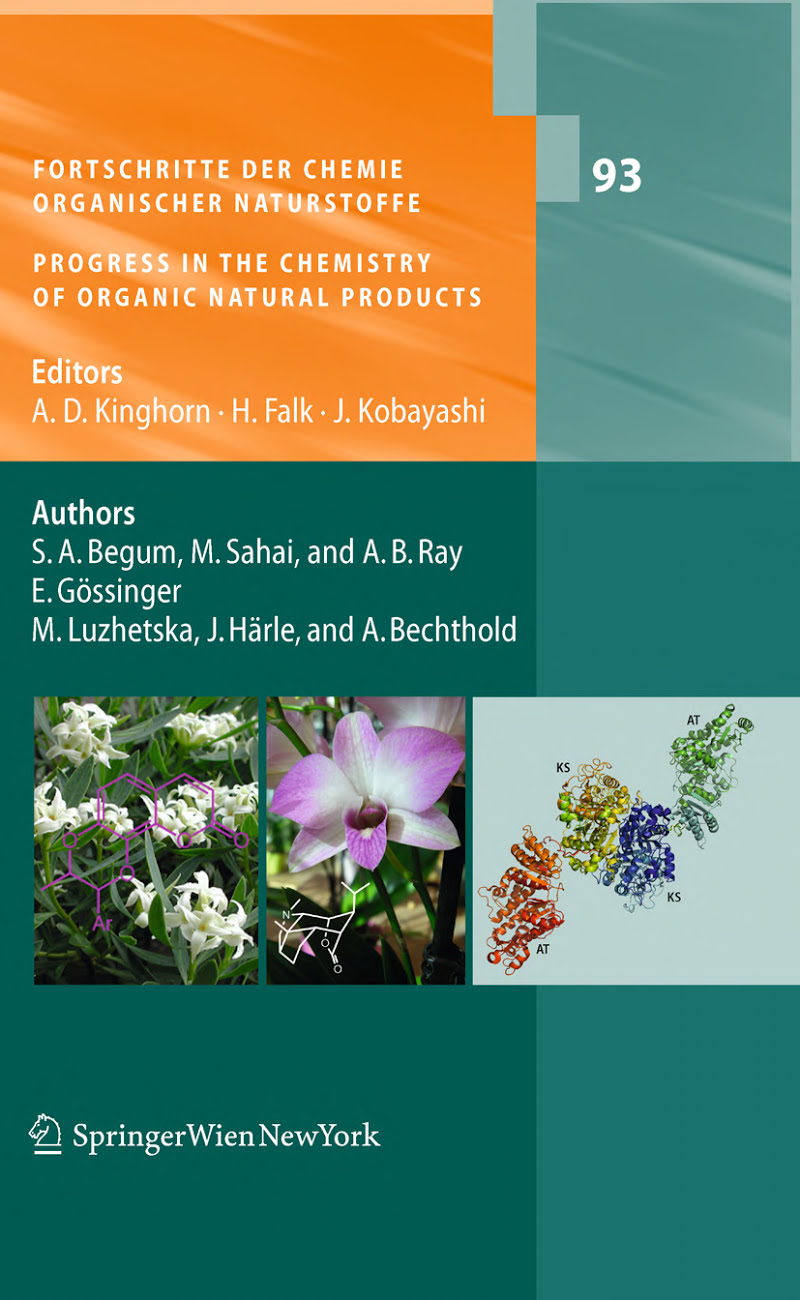
Fortschritte der Chemie organischer Naturstoffe / Progress in the Chemistry of Organic Natural Products

Fortschritte der Chemie organischer Naturstoffe / Progress in the Chemistry of Organic Natural Products

by Mahendra Sahai, Edda Gössinger, Marta Luzhetska, Johannes Härle, Sajeli A. Begum, Anil B. Ray

264 pages· 2010· ISBN 9783709101407
About
Lignans, by convention, are a group of natural products that are formed by linking two phenylpropanoid units (C C units) by oxidative coupling. Most importantly, in 6 3 a lignan, two (C C units) are bound through the central carbon of their side chains, 6 3 0 i. e. the 8 and 8 positions (1, 2). The occurrence of C C -dimers, linked at sites other 6 3 0 than the 8–8 positions, is also known and these compounds have been termed neolignans (3, 4). As these two groups of compounds have close structural as well as biosynthetic relationships, they are often associated together and incorporated under the general term “lignan” (5). The diverse structural categorization of true lignans and of a few neolignans is presented in Fig. 1. Through the years, several review articles or books covering different facets of lignans, including their ch- istry (6, 7), biogenesis (8), synthesis (9), and biological activities (10) have been published. Enduring research for the investigation of secondary metabolites of plants has evidenced some compounds that are biogenetically related to true lignans or neolignans but bear some features not discerned in conventional lignans. These compounds or groups of compounds have been termed as “non-conventional lignans”, and include coumarinolignans, ?avonolignans, and stilbenolignans. The non-conventional lignans, like the conventional ones, have two C C units linked 6 3 together but have additional structural features to place them also under the category of coumarins, ?avonoids, or stilbenes.

Discuss Fortschritte der Chemie organischer Naturstoffe / Progress in the Chemistry of Organic Natural Products with other readers

Join or start a book club for Fortschritte der Chemie organischer Naturstoffe / Progress in the Chemistry of Organic Natural Products on Readfeed. Live chat, shared reading progress, and AI discussion questions — free to get started.

Frequently asked questions

How do I join a book club for Fortschritte der Chemie organischer Naturstoffe / Progress in the Chemistry of Organic Natural Products?

Sign up free on Readfeed, then browse public clubs or start your own club with Fortschritte der Chemie organischer Naturstoffe / Progress in the Chemistry of Organic Natural Products as the current read. Invite friends with a share link and discuss together with live chat and AI discussion questions.

Can I discuss Fortschritte der Chemie organischer Naturstoffe / Progress in the Chemistry of Organic Natural Products with other readers online?

Yes. Readfeed book clubs let you chat live, share progress, and join discussions about Fortschritte der Chemie organischer Naturstoffe / Progress in the Chemistry of Organic Natural Products with readers worldwide — whether your club is virtual, in-person, or hybrid.

Is Readfeed free?

Yes. Creating an account and joining book clubs is free. Sign up to find readers who love the same books and start discussing today.