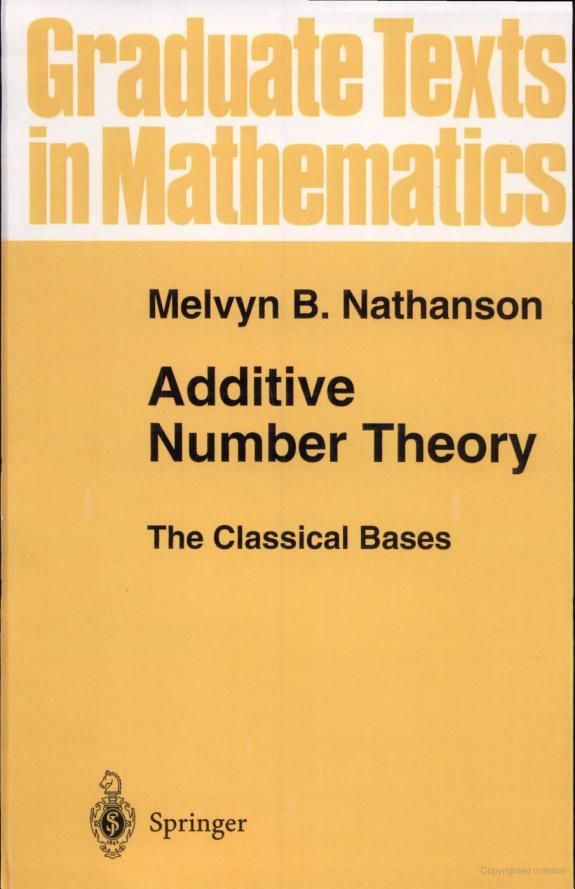
Additive Number Theory The Classical Bases

Additive Number Theory The Classical Bases

by Melvyn B. Nathanson

342 pages· 1996· ISBN 9780387946566
About
[Hilbert's] style has not the terseness of many of our modem authors in mathematics, which is based on the assumption that printer's labor and paper are costly but the reader's effort and time are not. H. Weyl [143] The purpose of this book is to describe the classical problems in additive number theory and to introduce the circle method and the sieve method, which are the basic analytical and combinatorial tools used to attack these problems. This book is intended for students who want to lel?Ill additive number theory, not for experts who already know it. For this reason, proofs include many "unnecessary" and "obvious" steps; this is by design. The archetypical theorem in additive number theory is due to Lagrange: Every nonnegative integer is the sum of four squares. In general, the set A of nonnegative integers is called an additive basis of order h if every nonnegative integer can be written as the sum of h not necessarily distinct elements of A. Lagrange 's theorem is the statement that the squares are a basis of order four. The set A is called a basis offinite order if A is a basis of order h for some positive integer h. Additive number theory is in large part the study of bases of finite order. The classical bases are the squares, cubes, and higher powers; the polygonal numbers; and the prime numbers. The classical questions associated with these bases are Waring's problem and the Goldbach conjecture.

Discuss Additive Number Theory The Classical Bases with other readers

Join or start a book club for Additive Number Theory The Classical Bases on Readfeed. Live chat, shared reading progress, and AI discussion questions — free to get started.

Frequently asked questions

How do I join a book club for Additive Number Theory The Classical Bases?

Sign up free on Readfeed, then browse public clubs or start your own club with Additive Number Theory The Classical Bases as the current read. Invite friends with a share link and discuss together with live chat and AI discussion questions.

Can I discuss Additive Number Theory The Classical Bases with other readers online?

Yes. Readfeed book clubs let you chat live, share progress, and join discussions about Additive Number Theory The Classical Bases with readers worldwide — whether your club is virtual, in-person, or hybrid.

Is Readfeed free?

Yes. Creating an account and joining book clubs is free. Sign up to find readers who love the same books and start discussing today.