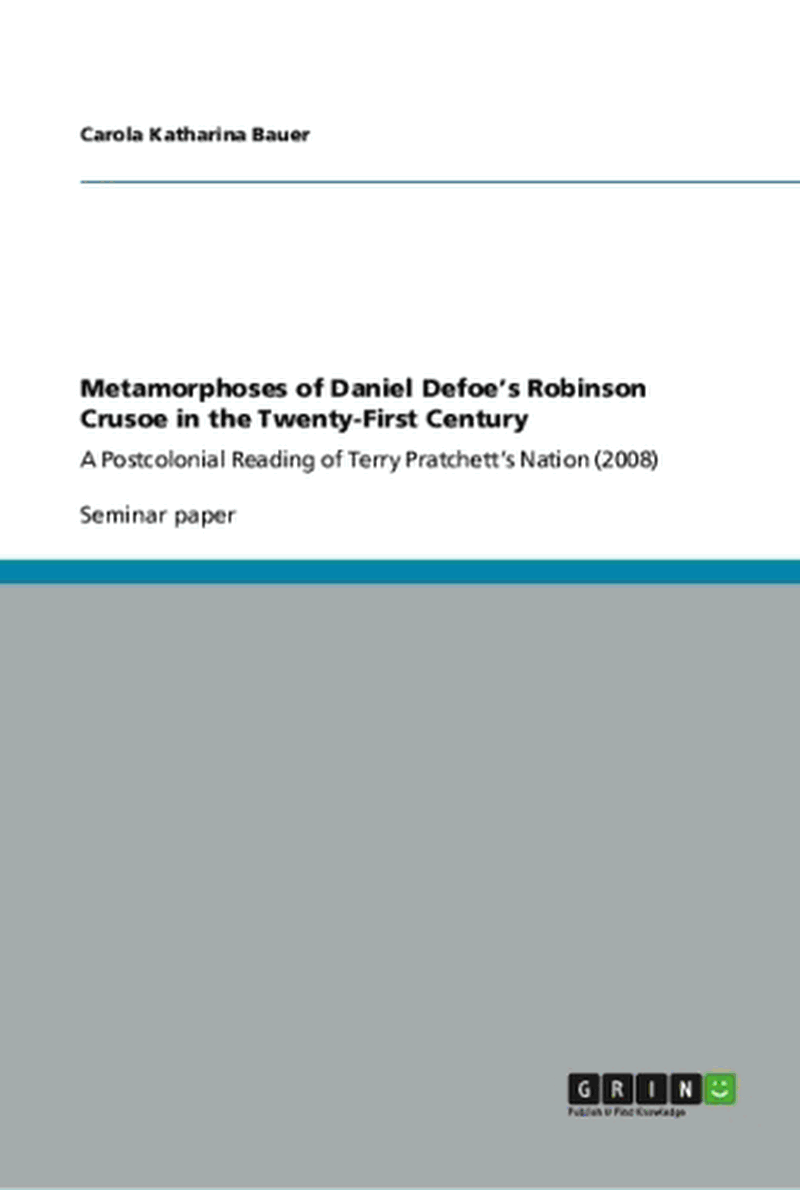
Metamorphoses of Daniel Defoe's Robinson Crusoe in the Twenty-First Century

Metamorphoses of Daniel Defoe's Robinson Crusoe in the Twenty-First Century

by Carola Katharina Bauer

28 pages· 2013· ISBN 9783656187882
About
Seminar paper from the year 2010 in the subject English Language and Literature Studies - Literature, grade: 1,00, University of Bayreuth, language: English, abstract: "There scarce exists a work so popular as Robinson Crusoe. It is read eagerly by young people; and there is hardly an elf so devoid of imagination as not to have supposed for himself a solitary island in which he could act Robinson Crusoe, were it but in the corner of the nursery." (Ballantyne 7) With these words, John Ballantyne reinstates Robinson Crusoe (1719) as a novel appealing to younger readers in his essay about "Daniel De Foe [sic]," published in 1810. And indeed: Although the implicit reader of the first novel in English literature was not specifically mentioned to be of young age, "children have been its principal readers throughout the [last 300] years" (Lundin 199). Thus, it is not surprising that novels also popular with a younger audience - such as Treasure Island by Robert Louis Stevenson - resemble the famous castaway narrative by repeating its main topics and motifs like the solitary island and the shipwreck (Green 143). One of the more recent adaptations of Robinson Crusoe is Terry Pratchett's Nation, published in 2008: Taking place "on a South Sea island in a skewed version of the 19th century" (Boyce), the story centers around the cultural encounter of the shipwrecked, adolescent daughter of a British colonial governor, called Daphne, with an indigenous boy named Mau, whose whole nation was obliterated by a tsunami. Whereas Robinson Crusoe can be clearly considered to be an imperialist and racist novel, with its protagonist becoming the "true symbol of the British conquest" - as James Joyce puts it in his essay about Daniel Defoe in 1912 (Joyce 10) - Pratchett's book has been appraised by critics as a "novel of ideas, a ferocious questioning of vested cultural attitudes and beliefs" (Dirda), and said to reveal "the stupidity of "ignorance and prejudices [i.e. concerning race]" (

Discuss Metamorphoses of Daniel Defoe's Robinson Crusoe in the Twenty-First Century with other readers

Join or start a book club for Metamorphoses of Daniel Defoe's Robinson Crusoe in the Twenty-First Century on Readfeed. Live chat, shared reading progress, and AI discussion questions — free to get started.

Frequently asked questions

How do I join a book club for Metamorphoses of Daniel Defoe's Robinson Crusoe in the Twenty-First Century?

Sign up free on Readfeed, then browse public clubs or start your own club with Metamorphoses of Daniel Defoe's Robinson Crusoe in the Twenty-First Century as the current read. Invite friends with a share link and discuss together with live chat and AI discussion questions.

Can I discuss Metamorphoses of Daniel Defoe's Robinson Crusoe in the Twenty-First Century with other readers online?

Yes. Readfeed book clubs let you chat live, share progress, and join discussions about Metamorphoses of Daniel Defoe's Robinson Crusoe in the Twenty-First Century with readers worldwide — whether your club is virtual, in-person, or hybrid.

Is Readfeed free?

Yes. Creating an account and joining book clubs is free. Sign up to find readers who love the same books and start discussing today.