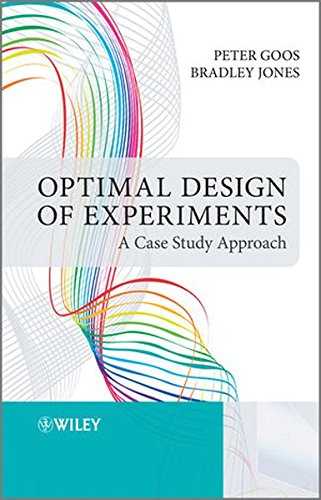
Optimal Design of Experiments: A Case Study Approach
by Peter Goos, Bradley Jones
"It's been said: 'Design for the experiment, don't experiment for the design.' This book ably demonstrates this notion by showing how tailor-made, optimal designs can be effectively employed to meet a client's actual needs. It should be required reading for anyone interested in using the design of experiments in industrial settings."
—Christopher J. Nachtsheim, Frank A Donaldson Chair in Operations Management, Carlson School of Management, University of Minnesota
This book demonstrates the utility of the computer-aided optimal design approach using real industrial examples. These examples address questions such as the following:
- How can I do screening inexpensively if I have dozens of factors to investigate?
- What can I do if I have day-to-day variability and I can only perform 3 runs a day?
- How can I do RSM cost effectively if I have categorical factors?
- How can I design and analyze experiments when there is a factor that can only be changed a few times over the study?
- How can I include both ingredients in a mixture and processing factors in the same study?
- How can I design an experiment if there are many factor combinations that are impossible to run?
- How can I make sure that a time trend due to warming up of equipment does not affect the conclusions from a study?
- How can I take into account batch information in when designing experiments involving multiple batches?
- How can I add runs to a botched experiment to resolve ambiguities?
While answering these questions the book also shows how to evaluate and compare designs. This allows researchers to make sensible trade-offs between the cost of experimentation and the amount of information they obtain.
Discuss Optimal Design of Experiments: A Case Study Approach with other readers
Join or start a book club for Optimal Design of Experiments: A Case Study Approach on Readfeed. Live chat, shared reading progress, and AI discussion questions — free to get started.
Frequently asked questions
How do I join a book club for Optimal Design of Experiments: A Case Study Approach?
Sign up free on Readfeed, then browse public clubs or start your own club with Optimal Design of Experiments: A Case Study Approach as the current read. Invite friends with a share link and discuss together with live chat and AI discussion questions.
Can I discuss Optimal Design of Experiments: A Case Study Approach with other readers online?
Yes. Readfeed book clubs let you chat live, share progress, and join discussions about Optimal Design of Experiments: A Case Study Approach with readers worldwide — whether your club is virtual, in-person, or hybrid.
Is Readfeed free?
Yes. Creating an account and joining book clubs is free. Sign up to find readers who love the same books and start discussing today.