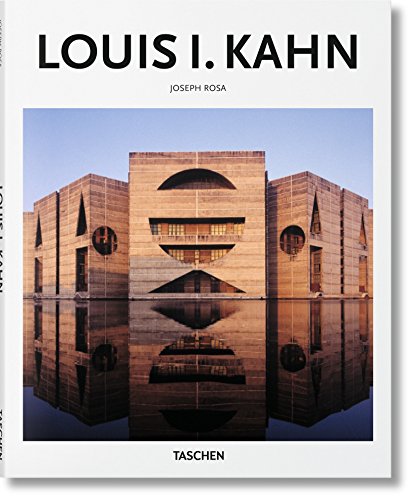
Kahn
by Joseph Rosa
96 pages· 2016· ISBN 9783836543842
About
Brilliant buildings
Louis Isadore Kahn and a luminous modernist language
Louis Isadore Kahn (1901–1974) treated each building like a temple. Across the United States, in India, Bangladesh, Pakistan, and Israel, his designs combined the sleek, utilitarian surfaces of modernism with a devotion to geometric forms and a reverence for natural light that suffused his structures with a monumental and breathtaking spirituality.
Kahn was born in Estonia in 1901 but emigrated with his family to Philadelphia, Pennsylvania, in 1906. He graduated from the University of Pennsylvania School of Fine Arts in 1924 and worked in different architecture offices before setting up his own atelier in 1934. Kahn devoted much time to the study of contemporary architecture and housing, blossoming with his own unique style in the last two decades of his life. His language combined the vocabulary of the International Style with a “back to basics” grammar inspired by his visits to ancient sites in Italy, Greece, and Egypt.
Above all, Kahn believed ardently in the interplay of light between mass and void. His masterworks, such as the National Assembly Building in Dhaka, Bangladesh, or Kimbell Art Museum in Forth Worth, Texas, exude their weight, their materials, and construction, but are pierced with such spotlights of sunshine, bathed in such natural light luminescence, as to acquire something celestial within their mass.
This essential introduction brings together 17 of Kahn’s most important buildings across his cultural, governmental, religious, and residential repertoire. Plans, views, descriptions, and quality photographs trace the context and development of each project, while an introductory essay explores Kahn’s unique architectural ideology and his legacy as one of the most important 20th-century American architects since Frank Lloyd Wright.
Louis Isadore Kahn and a luminous modernist language
Louis Isadore Kahn (1901–1974) treated each building like a temple. Across the United States, in India, Bangladesh, Pakistan, and Israel, his designs combined the sleek, utilitarian surfaces of modernism with a devotion to geometric forms and a reverence for natural light that suffused his structures with a monumental and breathtaking spirituality.
Kahn was born in Estonia in 1901 but emigrated with his family to Philadelphia, Pennsylvania, in 1906. He graduated from the University of Pennsylvania School of Fine Arts in 1924 and worked in different architecture offices before setting up his own atelier in 1934. Kahn devoted much time to the study of contemporary architecture and housing, blossoming with his own unique style in the last two decades of his life. His language combined the vocabulary of the International Style with a “back to basics” grammar inspired by his visits to ancient sites in Italy, Greece, and Egypt.
Above all, Kahn believed ardently in the interplay of light between mass and void. His masterworks, such as the National Assembly Building in Dhaka, Bangladesh, or Kimbell Art Museum in Forth Worth, Texas, exude their weight, their materials, and construction, but are pierced with such spotlights of sunshine, bathed in such natural light luminescence, as to acquire something celestial within their mass.
This essential introduction brings together 17 of Kahn’s most important buildings across his cultural, governmental, religious, and residential repertoire. Plans, views, descriptions, and quality photographs trace the context and development of each project, while an introductory essay explores Kahn’s unique architectural ideology and his legacy as one of the most important 20th-century American architects since Frank Lloyd Wright.
Discuss Kahn with other readers
Join or start a book club for Kahn on Readfeed. Live chat, shared reading progress, and AI discussion questions — free to get started.
Frequently asked questions
How do I join a book club for Kahn?
Sign up free on Readfeed, then browse public clubs or start your own club with Kahn as the current read. Invite friends with a share link and discuss together with live chat and AI discussion questions.
Can I discuss Kahn with other readers online?
Yes. Readfeed book clubs let you chat live, share progress, and join discussions about Kahn with readers worldwide — whether your club is virtual, in-person, or hybrid.
Is Readfeed free?
Yes. Creating an account and joining book clubs is free. Sign up to find readers who love the same books and start discussing today.