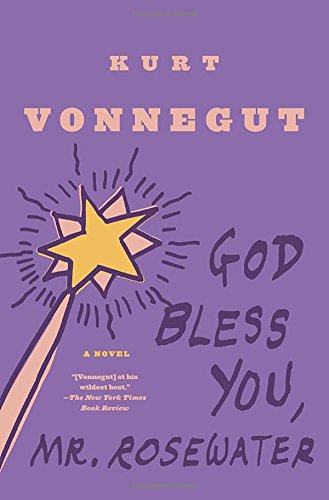
God Bless You, Mr. Rosewater
by Kurt Vonnegut, Kurt Vonnegut Jr.
288 pages· 1998· ISBN 9780385333474
About
Second only to Slaughterhouse-Five of Vonnegut's canon in its prominence and influence, God Bless You, Mr. Rosewater (1965) presents Eliot Rosewater, an itinerant, semi-crazed millionaire wandering the country in search of heritage and philanthropic outcome, introducing the science fiction writer Kilgore Trout to the world and Vonnegut to the collegiate audience which would soon make him a cult writer.
Trout, modeled according to Vonnegut on the science fiction writer Theodore Sturgeon (with whom Vonnegut had an occasional relationship) is a desperate, impoverished but visionary hack writer who functions for Eliot Rosewater as both conscience and horrid example. Rosewater, seeking to put his inheritance to some meaningful use (his father was an entrepreneur), tries to do good within the context of almost illimitable cynicism and corruption.
It is in this novel that Rosewater wanders into a science fiction conference--an actual annual event in Milford, Pennsylvania--and at the motel delivers his famous monologue evoked by science fiction writers and critics for almost half a century: "None of you can write for sour apples... but you're the only people trying to come to terms with the really terrific things which are happening today." Money does not drive Mr. Rosewater (or the corrupt lawyer who tries to shape the Rosewater fortune) so much as outrage at the human condition.
The novel was adapted for a 1979 Alan Menken musical. The novel is told mostly thru a collection of short stories dealing with Eliot's interactions with the citizens of Rosewater County, usually with the last sentence serving as a punch line. The antagonist's tale, Mushari's, is told in a similar short essay fashion. The stories reveal different hypocrisies of humankind in a darkly humorous fashion.
Trout, modeled according to Vonnegut on the science fiction writer Theodore Sturgeon (with whom Vonnegut had an occasional relationship) is a desperate, impoverished but visionary hack writer who functions for Eliot Rosewater as both conscience and horrid example. Rosewater, seeking to put his inheritance to some meaningful use (his father was an entrepreneur), tries to do good within the context of almost illimitable cynicism and corruption.
It is in this novel that Rosewater wanders into a science fiction conference--an actual annual event in Milford, Pennsylvania--and at the motel delivers his famous monologue evoked by science fiction writers and critics for almost half a century: "None of you can write for sour apples... but you're the only people trying to come to terms with the really terrific things which are happening today." Money does not drive Mr. Rosewater (or the corrupt lawyer who tries to shape the Rosewater fortune) so much as outrage at the human condition.
The novel was adapted for a 1979 Alan Menken musical. The novel is told mostly thru a collection of short stories dealing with Eliot's interactions with the citizens of Rosewater County, usually with the last sentence serving as a punch line. The antagonist's tale, Mushari's, is told in a similar short essay fashion. The stories reveal different hypocrisies of humankind in a darkly humorous fashion.
Discuss God Bless You, Mr. Rosewater with other readers
Join or start a book club for God Bless You, Mr. Rosewater on Readfeed. Live chat, shared reading progress, and AI discussion questions — free to get started.
Frequently asked questions
How do I join a book club for God Bless You, Mr. Rosewater?
Sign up free on Readfeed, then browse public clubs or start your own club with God Bless You, Mr. Rosewater as the current read. Invite friends with a share link and discuss together with live chat and AI discussion questions.
Can I discuss God Bless You, Mr. Rosewater with other readers online?
Yes. Readfeed book clubs let you chat live, share progress, and join discussions about God Bless You, Mr. Rosewater with readers worldwide — whether your club is virtual, in-person, or hybrid.
Is Readfeed free?
Yes. Creating an account and joining book clubs is free. Sign up to find readers who love the same books and start discussing today.