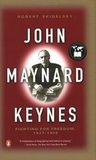
John Maynard Keynes: Volume 3: Fighting for Freedom, 1937-1946
by Robert Skidelsky
Dealing with the period from 1937, when Keynes had become the world's most famous economist and one of the most famous figures in Britain, to his death in 1946, Volume III focuses on Keynes's outstanding contribution to the financing of Britain's war effort, to the building of the post-war economic order, and on his role in the 'other war' - Britain's struggle to preserve its independence within the Atlantic Alliance, which took him on six wearying and often acrimonious missions to the United States.
Fighting for Britain opens in the twilight years between peace and war and draws a parallel between Keynes's own health and that of contemporary capitalism. Keynes's physical condition was, like his reputation, on a knife-edge. Suffering from heart disease, he spent nearly two years as a semi-invalid. But it was during this period that he showed how his General Theory of Employment, Interest, and Money was not just an anti-depression theory, but could be turned into a powerful intellectual engine of war finance.
The culmination of these efforts was his famous anti-inflationist tract How to Pay for the War, the logic of which, and supporting national income accounts, was accepted as the basis of Kingsley Wood's budget of 1941. For the rest of his life Keynes was involved in difficult financial negotiations with the Americans, first to establish conditions of American help to Britain, then to devise a post-war financial system which satisfied American requirements without sacrificing Britain's interests, and finally, and most traumatically, to get Britain a loan to tide it over the first post-war years. When he died in 1946, Lionel Robbins wrote, 'He gave his life for his country, as surely as if he had fallen on the field of battle.'
Skidelsky at all times is utterly lucid in his treatment of his subject, both in explaining Keynes's ideas and in picking his way through the complexities of his personality. The book abounds in good stories and memorable portraits, notably that of his devoted wife, Lydia Lopokova, whose eccentric but utterly logical 'post-Keynesian' existence is charted in a delightful epilogue, and of his flamboyant medical adviser, Janos Pesch.
Insightful and intelligent, this is a work that tells of one of the most important and fascinating men of the twentieth century and provides an invaluable overview of matters that remain at the centre of political and economic discussion.
Discuss John Maynard Keynes: Volume 3: Fighting for Freedom, 1937-1946 with other readers
Join or start a book club for John Maynard Keynes: Volume 3: Fighting for Freedom, 1937-1946 on Readfeed. Live chat, shared reading progress, and AI discussion questions — free to get started.
Frequently asked questions
How do I join a book club for John Maynard Keynes: Volume 3: Fighting for Freedom, 1937-1946?
Sign up free on Readfeed, then browse public clubs or start your own club with John Maynard Keynes: Volume 3: Fighting for Freedom, 1937-1946 as the current read. Invite friends with a share link and discuss together with live chat and AI discussion questions.
Can I discuss John Maynard Keynes: Volume 3: Fighting for Freedom, 1937-1946 with other readers online?
Yes. Readfeed book clubs let you chat live, share progress, and join discussions about John Maynard Keynes: Volume 3: Fighting for Freedom, 1937-1946 with readers worldwide — whether your club is virtual, in-person, or hybrid.
Is Readfeed free?
Yes. Creating an account and joining book clubs is free. Sign up to find readers who love the same books and start discussing today.