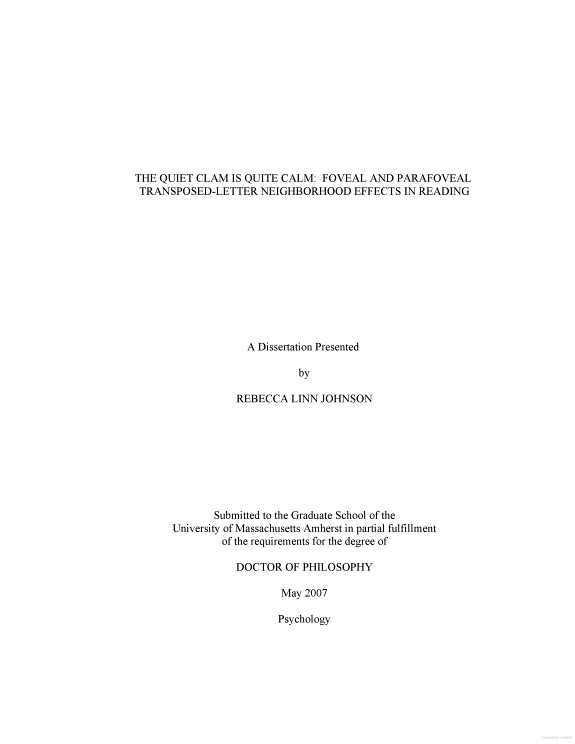
The Quiet Clam is Quite Calm: Foveal and Parafoveal Transposed-letter Neighborhood Effects in Reading

The Quiet Clam is Quite Calm: Foveal and Parafoveal Transposed-letter Neighborhood Effects in Reading

158 pages· 2007· ISBN 9780549171669
About
Previous research has found that when a word like "clam" is presented at the foveal level, its transposed-letter neighbor "calm" is also activated. This activation of multiple lexical candidates causes interference in naming and lexical decision tasks. Here, four eye-tracking experiments were conducted to explore the nature of transposed-letter (TL) neighborhood effects within the context of normal silent reading. Experiments 1 and 2 addressed the processing of target words that have a transposed-letter neighbor (e.g., angel, angle) in comparison to target words that do not have a transposed-letter neighbor (e.g., alien, slope ). Furthermore, Experiment 2 manipulated the sentence context leading up to the target word to explore whether semantic constraints can attenuate neighborhood interference effects. The results indicated that readers do take longer to process words that have a TL neighbor than words that do not have a TL neighbor. This interference effect, however, disappeared when the beginning of the sentence was constraining such that only one of the two members of the TL pair was likely. While both Experiments 1 and 2 explored effects at the foveal level, Experiments 3 and 4 explored the parafoveal processing of transposed-letter neighbors by employing an eye-movement-contingent boundary change paradigm. In Experiment 3, readers received a parafoveal preview of a TL target word that was either (1) identical to the target word (e.g., calm as the preview of calm), (2) a TL-neighbor (e.g., clam) or (3) a substituted-letter (SL) control (e.g., chem). In Experiment 4, a further set of parafoveal preview conditions was explored. Across both experiments, readers' fixation durations on the target words were significantly longer when the parafoveal previews were substituted-letter nonwords than when they were TL neighbors, suggesting that TL neighbors (when presented in the parafovea) facilitate word recognition, rather than inhibit processing. Collectively, these experiments indicate that TL neighborhood interference effects do occur in normal silent reading, but these effects occur late and are influenced by sentence constraints.

Discuss The Quiet Clam is Quite Calm: Foveal and Parafoveal Transposed-letter Neighborhood Effects in Reading with other readers

Join or start a book club for The Quiet Clam is Quite Calm: Foveal and Parafoveal Transposed-letter Neighborhood Effects in Reading on Readfeed. Live chat, shared reading progress, and AI discussion questions — free to get started.

Frequently asked questions

How do I join a book club for The Quiet Clam is Quite Calm: Foveal and Parafoveal Transposed-letter Neighborhood Effects in Reading?

Sign up free on Readfeed, then browse public clubs or start your own club with The Quiet Clam is Quite Calm: Foveal and Parafoveal Transposed-letter Neighborhood Effects in Reading as the current read. Invite friends with a share link and discuss together with live chat and AI discussion questions.

Can I discuss The Quiet Clam is Quite Calm: Foveal and Parafoveal Transposed-letter Neighborhood Effects in Reading with other readers online?

Yes. Readfeed book clubs let you chat live, share progress, and join discussions about The Quiet Clam is Quite Calm: Foveal and Parafoveal Transposed-letter Neighborhood Effects in Reading with readers worldwide — whether your club is virtual, in-person, or hybrid.

Is Readfeed free?

Yes. Creating an account and joining book clubs is free. Sign up to find readers who love the same books and start discussing today.