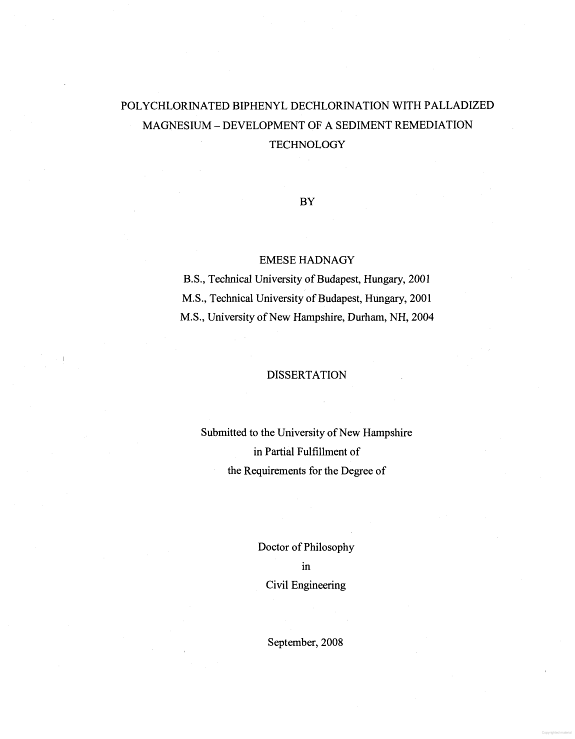
Polychlorinated Biphenyl Dechlorination with Palladized Magnesium - Development of a Sediment Remediation Technology

Polychlorinated Biphenyl Dechlorination with Palladized Magnesium - Development of a Sediment Remediation Technology

163 pages· 2008· ISBN 9780549878759
About
PCB contamination in sediments remains a significant problem in many rivers, harbors, and estuarine areas in the US and around the world. In this work, PCB dechlorination by palladium-coated magnesium (Mg/Pd, 0.01% by weight Pd) has been demonstrated in PCB-contaminated marine and freshwater sediments from New Bedford Harbor (NBH), MA; and the Housatonic River (HSR), MA. Experiments were also conducted in pure solvent systems (10% methanol in distilled water). In addition, the performance of an in-situ sediment remediation system capable of delivering and mixing chemical amendments into sub-aqueous sediments and at the same time providing enclosed conditions was evaluated by mixing activated carbon (AC) into Cocheco River, NH sediment. The higher organic and silt/clay content NBH sediment had lower overall dechlorination than the sandy HSR sediment with lower organic content; PCB desorption from the sediments did not limit dechlorination rates. Formation of lower chlorinated congeners could be observed in the HSR sediment, mostly pentachlorobiphenyls or lesser chlorinated congeners, and was also confirmed in experiments conducted with single PCB congeners BZ 194 and 204 in pure solvents, indicating that dechlorination was occurring. A stepwise dechlorination process was suggested in which chlorines in the ortho position were removed last. The use of methanol, ethanol and isopropanol to enhance dechlorination by increasing contaminant solubility proved to be inefficient in both sediments when compared to water. The bioavailability of PCBs decreased by 78.0%, 59.9%, and 66.7% in the sandy HSR sediment in the presence of water, ethanol and isopropanol (with associated mass removals of 48.3%, 52.2% and 17.9%, respectively), indicating that the majority of the contaminants that were not accessible for dechlorination were not bioavailable. In the in-situ sediment remediation system evaluation, better amendment recoveries were observed at lower added AC volumes, at lower pump flow rates, at faster mixing speeds, and at horizontal locations closer to the center shaft. In general, poor amendment recoveries could be attributed to the limited capacity of the sediment pore space to accommodate the AC slurry. Even though not all amendment was mixed successfully into the sediment the reagent stayed within the enclosure of the device, indicating that contained mixing conditions were achieved.

Discuss Polychlorinated Biphenyl Dechlorination with Palladized Magnesium - Development of a Sediment Remediation Technology with other readers

Join or start a book club for Polychlorinated Biphenyl Dechlorination with Palladized Magnesium - Development of a Sediment Remediation Technology on Readfeed. Live chat, shared reading progress, and AI discussion questions — free to get started.

Frequently asked questions

How do I join a book club for Polychlorinated Biphenyl Dechlorination with Palladized Magnesium - Development of a Sediment Remediation Technology?

Sign up free on Readfeed, then browse public clubs or start your own club with Polychlorinated Biphenyl Dechlorination with Palladized Magnesium - Development of a Sediment Remediation Technology as the current read. Invite friends with a share link and discuss together with live chat and AI discussion questions.

Can I discuss Polychlorinated Biphenyl Dechlorination with Palladized Magnesium - Development of a Sediment Remediation Technology with other readers online?

Yes. Readfeed book clubs let you chat live, share progress, and join discussions about Polychlorinated Biphenyl Dechlorination with Palladized Magnesium - Development of a Sediment Remediation Technology with readers worldwide — whether your club is virtual, in-person, or hybrid.

Is Readfeed free?

Yes. Creating an account and joining book clubs is free. Sign up to find readers who love the same books and start discussing today.