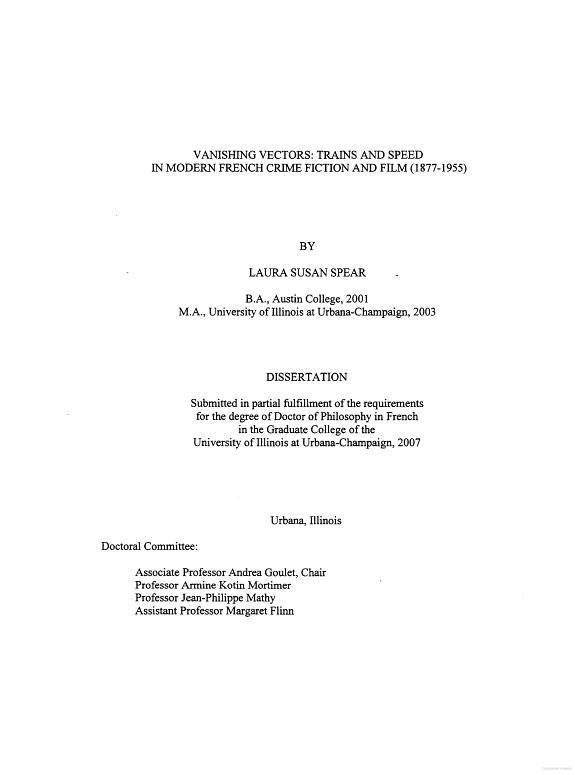
Vanishing Vectors: Trains and Speed in Modern French Crime Fiction and Film (1877--1955).

Vanishing Vectors: Trains and Speed in Modern French Crime Fiction and Film (1877--1955).

340 pages· 2007· ISBN 9780549464815
About
In this dissertation, I explore how the human body and the train interact as vehicles of modernity, from the forceful criminalization of the train at the end of the 19th century in Emile Zola's La bete humaine to a major advancement in train technology in the mid-20 th century, the electrification of the rails, in Rene Clement's La bataille du rail. I draw together key moments of crime and violence aboard trains in a wide variety of French literary and cinematic genres, such as Louis Feuillade's silent crime serials, spy novels of the 1930s, and romans noirs of the 1940s and 50s to show that violence, trains, and individuals are intimately bound together in society's desire for progress. Applying the terminology used by Paul Virilio in his analysis of the "dromocratie" (the modern society of speed), I investigate how human and machine movements resemble vectors. By isolating vectors' rapid trajectories, I map out these itineraries in texts concentrated around three key historical moments for the railways: the Belle Epoque, the interwar years, and World War II. Zola's railway microcosm provides the first glimpse into how the dynamic and unstable interactions among workers fuel the desire for crime and violence in a society of speed, which I further explore in numerous examples of the Belle Epoque polar. Next, the threat of the railways heightens, as trains like the Orient Express ventured beyond national borders toward precarious international encounters that would eventually erupt in World War II, as in the battle of the rails. Over nearly a century of French literature and film, I have discovered a critical shift in the representation of the railways through crime and violence. From the restrictive interior space of the train compartment to the internationalization of the rails, crime fiction shifts focus to the railway network itself. By the mid-20th century, modernity and speed have heightened the criminality of railway space, radiating from an individual cabin to the general system of movement.

Discuss Vanishing Vectors: Trains and Speed in Modern French Crime Fiction and Film (1877--1955). with other readers

Join or start a book club for Vanishing Vectors: Trains and Speed in Modern French Crime Fiction and Film (1877--1955). on Readfeed. Live chat, shared reading progress, and AI discussion questions — free to get started.

Frequently asked questions

How do I join a book club for Vanishing Vectors: Trains and Speed in Modern French Crime Fiction and Film (1877--1955).?

Sign up free on Readfeed, then browse public clubs or start your own club with Vanishing Vectors: Trains and Speed in Modern French Crime Fiction and Film (1877--1955). as the current read. Invite friends with a share link and discuss together with live chat and AI discussion questions.

Can I discuss Vanishing Vectors: Trains and Speed in Modern French Crime Fiction and Film (1877--1955). with other readers online?

Yes. Readfeed book clubs let you chat live, share progress, and join discussions about Vanishing Vectors: Trains and Speed in Modern French Crime Fiction and Film (1877--1955). with readers worldwide — whether your club is virtual, in-person, or hybrid.

Is Readfeed free?

Yes. Creating an account and joining book clubs is free. Sign up to find readers who love the same books and start discussing today.