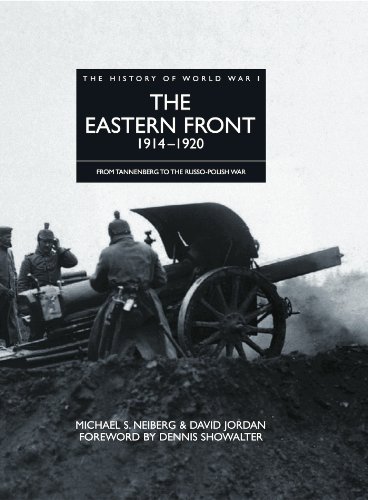
History of World War I: The Eastern Front 1914-1920: From Tannenberg to the Russo-Polish War
by Michael S. Neiberg, David Jordan
In 1914, the autocratic Russian Empire was allied to the democracies of France and Great Britain – and the small Kingdom of Serbia – through a series of treaties concluded in the late nineteenth and early twentieth centuries, and designed to counter the threat of the Central Powers of Germany and Austria-Hungary.
With the outbreak of war in August, the Russian forces mobilized and moved into the attack. Despite being outnumbered, the German commander, Paul von Hindenburg, destroyed one Russian army at the Battle of Tannenberg in August 1914, before defeating another at the Battle of the Masurian Lakes the following month. The Russians fared better against the Austro-Hungarian forces further south in Galicia, before reluctant German intervention to help their allies stabilized the situation.
The year 1915 saw the German High Command switch their main effort to the Eastern Front, resulting in the decisive German victory at Gorlice-Tarnow, and the subsequent capture of Warsaw and hundreds of square miles of formerly Russian-controlled territory.
The Russian Brusilov Offensive in the summer of 1916 and the Romanian entry into the war on the Allied side saw the latter's fortunes revive, but the success proved to be only temporary. Brusilov's attack stalled, while Romania was effectively knocked out of the war by a joint Central Powers offensive led by Germany and Bulgaria.
Increasing unrest in Russia culminated in the first revolution of 1917 and the abdication of Tsar Nicholas II. The offensives of the Russian Provisional Government failed, and a second revolution in November saw Lenin's Bolsheviks seize power. Having made peace with the Central Powers, the Bolsheviks fought the anti-Bolshevik 'White' Russian forces in the Civil War that followed, while a number of Allied powers sent forces to help the Whites. This conflict, combined with war with the newly-revived state of Poland in 1919, meant that large-scale fighting in Russia did not end until late 1920.
The length of the front in the East was much longer than in the West. The theatre of war was roughly delimited by the Baltic Sea in the West and Moscow in the East, a distance of 1,200 kilometres, and Saint Petersburg in the North and the Black Sea in the South, a distance of more than 1,600 kilometres. This had a drastic effect on the nature of the warfare. While World War I on the Western Front developed into trench warfare for much of the war, the battle lines on the Eastern Front were much more fluid, and trenches never truly developed.
The greater length of the front ensured that the density of soldiers in the line was lower so the line was easier to break. Once broken, the sparse communication networks made it difficult for the defender to rush reinforcements to the rupture in the line to mount a rapid counteroffensive and seal off a breakthrough. The terrain in the Eastern European theatre was quite solid, often making it near impossible to construct anything resembling the complicated trench systems on the Western Front, which tended to have muddier and much more workable terrain. In short, in the east the side defending did not have the overwhelming advantages it had on the Western Front. In fact the greatest advance of the whole war was made in the East by the German Army in the summer of 1915.
With the aid of over 300 black and white and colour photographs, complemented by full-colour maps, The Eastern Front provides a detailed guide to the background and conduct of the conflict on the Eastern Front, up to and including the Russian Civil War and the Russo-Polish War.
Discuss History of World War I: The Eastern Front 1914-1920: From Tannenberg to the Russo-Polish War with other readers
Join or start a book club for History of World War I: The Eastern Front 1914-1920: From Tannenberg to the Russo-Polish War on Readfeed. Live chat, shared reading progress, and AI discussion questions — free to get started.
Frequently asked questions
How do I join a book club for History of World War I: The Eastern Front 1914-1920: From Tannenberg to the Russo-Polish War?
Sign up free on Readfeed, then browse public clubs or start your own club with History of World War I: The Eastern Front 1914-1920: From Tannenberg to the Russo-Polish War as the current read. Invite friends with a share link and discuss together with live chat and AI discussion questions.
Can I discuss History of World War I: The Eastern Front 1914-1920: From Tannenberg to the Russo-Polish War with other readers online?
Yes. Readfeed book clubs let you chat live, share progress, and join discussions about History of World War I: The Eastern Front 1914-1920: From Tannenberg to the Russo-Polish War with readers worldwide — whether your club is virtual, in-person, or hybrid.
Is Readfeed free?
Yes. Creating an account and joining book clubs is free. Sign up to find readers who love the same books and start discussing today.