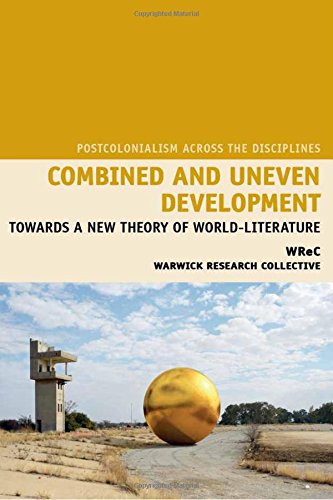
Combined and Uneven Development: Towards a New Theory of World-Literature (Postcolonialism Across the Disciplines LUP)

Combined and Uneven Development: Towards a New Theory of World-Literature (Postcolonialism Across the Disciplines LUP)

by Upamanyu Pablo Mukherjee, Stephen Shapiro, Neil Lazarus, Benita Parry, Graeme MacDonald, Nicholas Lawrence, Sharae Deckard

256 pages· 2015· ISBN 9781781381915
About
The ambition of this book is to resituate the problem of 'world literature', considered as a revived category of theoretical enquiry, by pursuing the literary-cultural implications of the theory of combined and uneven development. This theory has a long pedigree in the social sciences, where it continues to stimulate debate. But its implications for cultural analysis have received less attention, even though the theory might be said to draw attention to a central -perhaps the central - arc or trajectory of modern(ist) production in literature and the other arts worldwide. It is in the conjuncture of combined and uneven development, on the one hand, and the recently interrogated and expanded categories of 'world literature' and 'modernism', on the other, that this book looks for its specific contours. In the two theoretical chapters that frame the book, the authors argue for a single, but radically uneven world-system; a singular modernity, combined and uneven; and a literature that variously registers this combined unevenness in both its form and content to reveal itself as, properly speaking, world-literature. In the four substantive chapters that then follow, the authors explore a selection of modern-era fictions in which the potential of their method of comparativism seems to be most dramatically highlighted. They treat the novel paradigmatically, not exemplarily, as a literary form in which combined and uneven development is manifested with particular salience, due in no small part to its fundamental association with the rise of capitalism and its status in peripheral and semi-peripheral societies as a 'modernising' import. The peculiar plasticity and hybridity of the novel form enables it to incorporate not only multiple literary levels, genres and modes, but also other non-literary and archaic cultural forms - so that, for example, realist elements might be mixed with more experimental modes of narration, or older literary devices might be reactivated in juxtaposition with more contemporary frames.

Discuss Combined and Uneven Development: Towards a New Theory of World-Literature (Postcolonialism Across the Disciplines LUP) with other readers

Join or start a book club for Combined and Uneven Development: Towards a New Theory of World-Literature (Postcolonialism Across the Disciplines LUP) on Readfeed. Live chat, shared reading progress, and AI discussion questions — free to get started.

Frequently asked questions

How do I join a book club for Combined and Uneven Development: Towards a New Theory of World-Literature (Postcolonialism Across the Disciplines LUP)?

Sign up free on Readfeed, then browse public clubs or start your own club with Combined and Uneven Development: Towards a New Theory of World-Literature (Postcolonialism Across the Disciplines LUP) as the current read. Invite friends with a share link and discuss together with live chat and AI discussion questions.

Can I discuss Combined and Uneven Development: Towards a New Theory of World-Literature (Postcolonialism Across the Disciplines LUP) with other readers online?

Yes. Readfeed book clubs let you chat live, share progress, and join discussions about Combined and Uneven Development: Towards a New Theory of World-Literature (Postcolonialism Across the Disciplines LUP) with readers worldwide — whether your club is virtual, in-person, or hybrid.

Is Readfeed free?

Yes. Creating an account and joining book clubs is free. Sign up to find readers who love the same books and start discussing today.