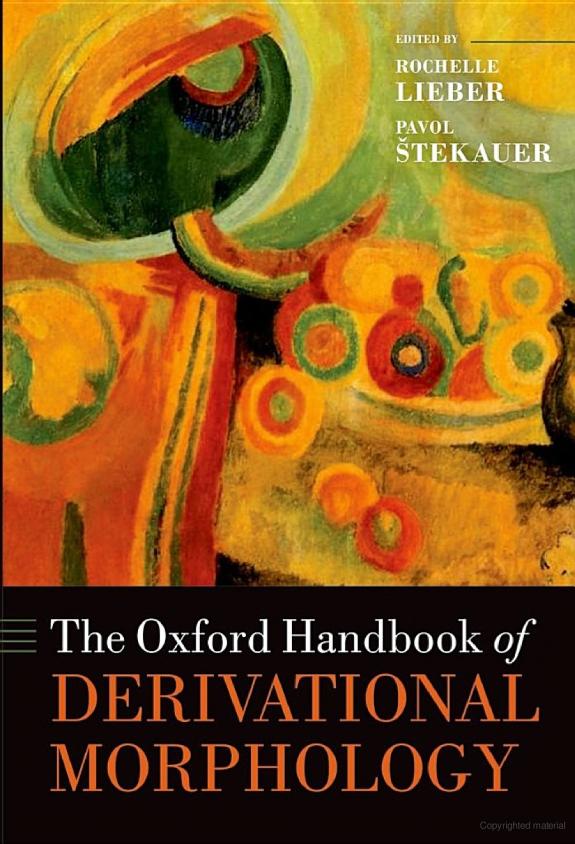
The Oxford Handbook of Derivational Morphology

The Oxford Handbook of Derivational Morphology

by Rochelle Lieber, Pavol Stekauer

768 pages· 2014· ISBN 9780191651786
About
The Oxford Handbook of Derivational Morphology is intended as a companion volume to the Oxford Handbook of Compounding (OUP 2009), aiming to provide a comprehensive and thorough overview of the study of derivational morphology. Written by distinguished scholars, its 41 chapters are devoted to theoretical and definitional matters, formal and semantic issues, interdisciplinary connections, and detailed descriptions of derivational processes in a wide range of language families. It presents the reader with the current state of the art in the study of derivational morphology. The handbook begins with an overview and a consideration of definitional matters, distinguishing derivation from inflection on the one hand and compounding on the other. From a formal perspective, the handbook treats affixation (prefixation, suffixation, infixation, circumfixation, etc.), conversion, reduplication, root and pattern and other templatic processes, as well as prosodic and subtractive means of forming new words. From a semantic perspective, it looks at the processes that form various types of adjectives, adverbs, nouns, and verbs, as well as evaluatives and the rarer processes that form function words. Chapters are devoted to issues of theory, methodology, the historical development of derivation, and to child language acquisition, sociolinguistic, experimental, and psycholinguistic approaches. The second half of the book surveys derivation in fifteen language families that are widely dispersed in terms of both geographical location and typological characteristics. It ends with a consideration of both areal tendencies in derivation and the issue of universals.

Discuss The Oxford Handbook of Derivational Morphology with other readers

Join or start a book club for The Oxford Handbook of Derivational Morphology on Readfeed. Live chat, shared reading progress, and AI discussion questions — free to get started.

Frequently asked questions

How do I join a book club for The Oxford Handbook of Derivational Morphology?

Sign up free on Readfeed, then browse public clubs or start your own club with The Oxford Handbook of Derivational Morphology as the current read. Invite friends with a share link and discuss together with live chat and AI discussion questions.

Can I discuss The Oxford Handbook of Derivational Morphology with other readers online?

Yes. Readfeed book clubs let you chat live, share progress, and join discussions about The Oxford Handbook of Derivational Morphology with readers worldwide — whether your club is virtual, in-person, or hybrid.

Is Readfeed free?

Yes. Creating an account and joining book clubs is free. Sign up to find readers who love the same books and start discussing today.