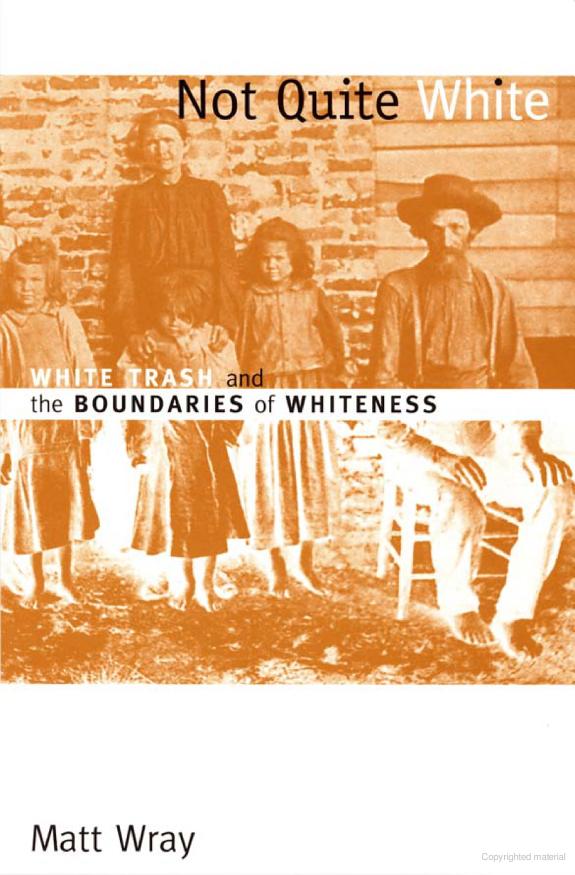
Not Quite White
White Trash and the Boundaries of Whiteness
by Matt Wray
213 pages· 2006· ISBN 9780822388593
About
White trash. The phrase conjures up images of dirty rural folk who are poor, ignorant, violent, and incestuous. But where did this stigmatizing phrase come from? And why do these stereotypes persist? Matt Wray answers these and other questions by delving into the long history behind this term of abuse and others like it. Ranging from the early 1700s to the early 1900s, Not Quite White documents the origins and transformations of the multiple meanings projected onto poor rural whites in the United States. Wray draws on a wide variety of primary sources—literary texts, folklore, diaries and journals, medical and scientific articles, social scientific analyses—to construct a dense archive of changing collective representations of poor whites. Of crucial importance are the ideas about poor whites that circulated through early-twentieth-century public health campaigns, such as hookworm eradication and eugenic reforms. In these crusades, impoverished whites, particularly but not exclusively in the American South, were targeted for interventions by sanitarians who viewed them as “filthy, lazy crackers” in need of racial uplift and by eugenicists who viewed them as a “feebleminded menace” to the white race, threats that needed to be confined and involuntarily sterilized. Part historical inquiry and part sociological investigation, Not Quite White demonstrates the power of social categories and boundaries to shape social relationships and institutions, to invent groups where none exist, and to influence policies and legislation that end up harming the very people they aim to help. It illuminates not only the cultural significance and consequences of poor white stereotypes but also how dominant whites exploited and expanded these stereotypes to bolster and defend their own fragile claims to whiteness.
Discuss Not Quite White with other readers
Join or start a book club for Not Quite White on Readfeed. Live chat, shared reading progress, and AI discussion questions — free to get started.
Frequently asked questions
How do I join a book club for Not Quite White?
Sign up free on Readfeed, then browse public clubs or start your own club with Not Quite White as the current read. Invite friends with a share link and discuss together with live chat and AI discussion questions.
Can I discuss Not Quite White with other readers online?
Yes. Readfeed book clubs let you chat live, share progress, and join discussions about Not Quite White with readers worldwide — whether your club is virtual, in-person, or hybrid.
Is Readfeed free?
Yes. Creating an account and joining book clubs is free. Sign up to find readers who love the same books and start discussing today.