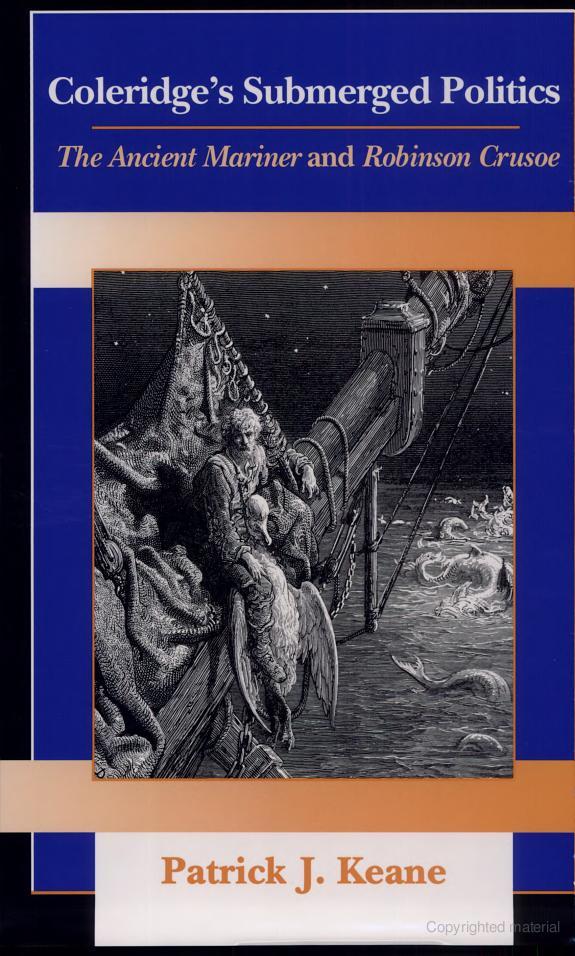
Coleridge's Submerged Politics

Coleridge's Submerged Politics

The Ancient Mariner and Robinson Crusoe

by Patrick J. Keane

419 pages· 1994· ISBN 9780826209429
About
Coleridge's Submerged Politics explores Coleridge's response to several crucial issues of the revolutionary and post-revolutionary age: the rise and suppression of English radicalism during the decade of the French Revolution and the tragic questions of slavery and the slave trade. The book consists of two distinct but intimately related sections. Starting with omissions in Coleridge's annotations on Robinson Crusoe, Part I traces his positions on race and slavery, connecting Defoe's novel and the slave-trading of its hero with the spectre-bark of The Ancient Mariner considered by several earlier critics as an abolitionist's allusion to the horrors of a slave ship. Keane discusses the numerous similarities that link these two haunting texts: their intertwined motifs of sea, sin, and existential solitude, of transgression, punishment, and at least partial redemption. More important, however, is Keane's treatment of the transfigured but recognizable domestic politics in and beneath the text of Coleridge's poem. Part II argues that imagery and plot developments in The Ancient Mariner reflect political events between November 1797 and March 1798, the months when Coleridge was writing and revising his poem and contributing anti-Pittite verses and essays to the widely read opposition newspaper the Morning Post. Keane steers a balanced course, insisting on the significance of the poem's sociopolitical context without reducing it to a token of its genesis. Though the book is part of the increasingly widespread movement to reinstate historical context as a ground of literary interpretation, Keane does not claim that The Ancient Mariner "says" one thing and "means" another - or is really about either Western guilt regarding the slave trade or Coleridge's own dangerous political voyaging during the months he was working on the poem. By treating The Ancient Mariner as a work of artistic transformation rather than political allegory or an "evasion" of politics, the author allows us to see the poem with an eye that is neither anti-historically "aesthetic" nor necessarily "ideological." As a result, The Ancient Mariner emerges with its interpretation-defeating mystery intact and as a poem to be read, re-created, and wondered about anew.

Discuss Coleridge's Submerged Politics with other readers

Join or start a book club for Coleridge's Submerged Politics on Readfeed. Live chat, shared reading progress, and AI discussion questions — free to get started.

Frequently asked questions

How do I join a book club for Coleridge's Submerged Politics?

Sign up free on Readfeed, then browse public clubs or start your own club with Coleridge's Submerged Politics as the current read. Invite friends with a share link and discuss together with live chat and AI discussion questions.

Can I discuss Coleridge's Submerged Politics with other readers online?

Yes. Readfeed book clubs let you chat live, share progress, and join discussions about Coleridge's Submerged Politics with readers worldwide — whether your club is virtual, in-person, or hybrid.

Is Readfeed free?

Yes. Creating an account and joining book clubs is free. Sign up to find readers who love the same books and start discussing today.